Have you heard about the fifth state of matter? It’s called Bose-Einstein condensate, or BEC for short. This amazing state exists at extremely cold temperatures. In fact, it’s colder than anything found naturally in the universe. Scientists create it in special laboratories using advanced cooling techniques. As a result, we can observe quantum effects on a large scale.
Key Takeaways
- All things considered, BEC forms at extremely low temperatures near absolute zero.
- Bosons occupy the same quantum state together in this state.
- Scientists create BEC through laser cooling, magnetic trapping, and evaporative cooling.
- The properties include superfluidity, coherence, and macroscopic quantum effects.
- This discovery has revolutionized our understanding of quantum mechanics.
What Is Bose-Einstein Condensate Explained Simple?
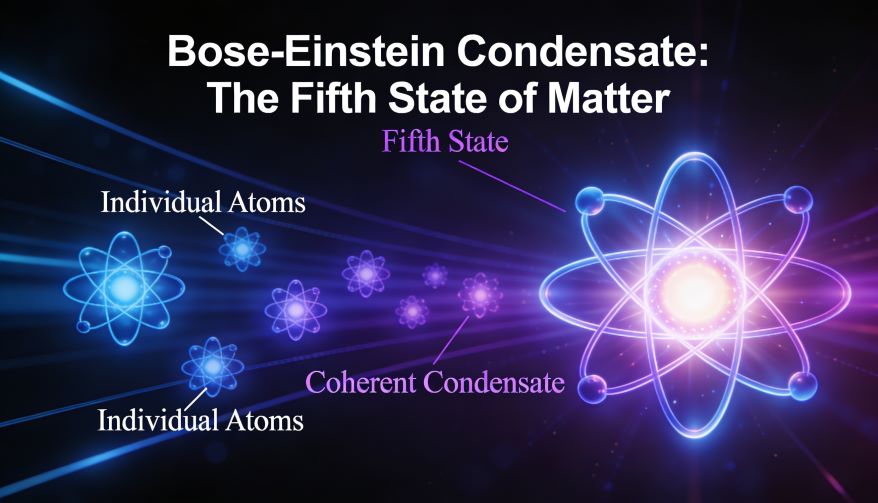
A Bose-Einstein condensate forms when special particles cool near absolute zero. To explain further, these particles are called bosons. At incredibly low temperatures, bosons behave in a unique way. They all occupy the same quantum state together. This makes them act like one giant super-atom. In essence, quantum mechanics becomes visible to our eyes.
“A Bose-Einstein condensate is a state of matter formed when a dilute gas of bosons is cooled to temperatures near absolute zero, causing a large fraction of atoms to occupy the same lowest-energy quantum state.”
The History Behind BEC
Two brilliant scientists predicted this state in the 1920s. Satyendra Nath Bose was an Indian physicist who studied particle statistics. Albert Einstein extended Bose’s work to atoms. Together, they predicted this new state of matter in 1924-1925. However, it took 70 years to actually create BEC in a laboratory.
In 1995, scientists Eric Cornell and Carl Wieman achieved this breakthrough. They used rubidium-87 atoms to create the first BEC. This amazing discovery earned them the 2001 Nobel Prize in Physics. As can be seen, their work opened new doors in quantum physics.
Understanding Bosons and Fermions
Bosons are particles with a special property called integer spin. To illustrate, photons and certain atoms are bosons. These particles follow Bose-Einstein statistics. At the same time, multiple bosons can occupy the same quantum state. This property is crucial for forming BEC.
In contrast, fermions have half-integer spin. Electrons, protons, and neutrons are examples of fermions. They follow the Pauli exclusion principle. That is to say, no two fermions can be in the same state. This makes fermions unable to form BEC under normal conditions.
How Scientists Create Bose-Einstein Condensate Explained Simple
Step 1: Laser Cooling
Scientists start by using lasers to slow down atoms. Laser cooling reduces the atoms’ movement significantly. The atoms become colder as they slow down. This process brings them to temperatures near a millionth of a degree. However, this isn’t cold enough for BEC yet.
Step 2: Magnetic Trapping
After that, scientists use magnetic fields to trap the cooled atoms. Magnetic traps hold the atoms in a confined space. As a result, it keeps them from touching the container walls. As a matter of fact, any contact would warm them up instantly.
Step 3: Evaporative Cooling
The final step involves evaporative cooling to reach ultra-low temperatures. Scientists remove the hottest atoms from the trap systematically. The remaining atoms become even colder through this process. Eventually, temperatures reach just billionths of a degree above absolute zero. At this point, BEC finally forms.
Special Properties of BEC
BEC has several special properties for example, Superfluidity, Coherence like Light, and Macroscopic Quantum Effects.
Superfluidity
One remarkable property of BEC is superfluidity. This means the condensate can flow without any friction whatsoever. To put it another way, it never loses energy while moving. Scientists have observed BEC flowing in circles that never stop. This behavior is completely different from normal liquids.
Coherence Like Light
BEC shows coherence similar to laser light. All atoms move together in perfect harmony. They act as matter waves instead of individual particles. In similar fashion to laser beams, these matter waves stay synchronized. This property indeed makes BEC useful for precision measurements.
Macroscopic Quantum Effects
Normally, quantum effects are invisible to human eyes. However, BEC makes quantum mechanics visible on a large scale. We can observe macroscopic quantum behavior directly. This helps scientists study quantum physics in new ways.
The Critical Temperature for BEC
BEC only forms below a specific critical temperature. This temperature depends on the type of atoms used. For the most part, it’s extremely close to absolute zero. At this temperature, something special happens to the atoms’ wavelengths.
The de Broglie wavelength of each atom starts to expand. Sooner or later, these wavelengths begin to overlap with neighboring atoms. When this happens, the atoms can no longer be distinguished individually. With the result that, they merge into a single quantum state.
Real-World Applications of Bose-Einstein Condensate

BEC or Bose-Einstein Condensate has many Real world Applications. Following are some of the Applications.
Precise Measurements
Scientists use BEC for extremely accurate measurements. Atomic clocks benefit from BEC technology. These clocks are the most precise timekeeping devices ever created. In addition, BEC helps measure gravitational forces with great accuracy.
Quantum Computing
BEC research contributes to quantum computing development. The coherent properties of BEC are useful for quantum information processing. With this in mind, scientists explore BEC for future quantum technologies.
Studying Fundamental Physics
Above all, BEC helps us understand the fundamental nature of matter. It allows scientists to test quantum theories in practical ways. Research on BEC continues to reveal new quantum phenomena.
Why BEC Matters
Understanding Bose-Einstein condensate explained simple opens doors to modern physics. This knowledge connects classical and quantum worlds beautifully. At the present time, BEC research leads to many technological advances. Learning about BEC prepares you for future scientific discoveries.
In conclusion, BEC represents one of the most fascinating states of matter. It demonstrates how quantum mechanics operates in our physical world. To sum up, this ultra-cold state shows nature’s most interesting behaviors.
Additionally, to stay updated with the latest developments in STEM research, visit STEM Quiz.
Frequently Asked Questions
A Bose–Einstein Condensate is a state of matter formed when particles called bosons are cooled to near absolute zero. However it causing them to occupy the same quantum state and behave like a single entity.
It is called the fifth state. However, it exists beyond solids, liquids, gases, and plasma. Which showing unique quantum properties.
BEC forms at extremely low temperatures. Which is close to absolute zero (0 Kelvin or -273.15°C).
The concept was predicted by Satyendra Nath Bose and Albert Einstein in the 1920s and experimentally created in 1995.
Scientists use laser cooling and magnetic traps to slow down atoms. Where there is extremely low temperatures. As a result, allowing them to merge into a single quantum state.
Reference
- Svidzinsky, A. A. (2022). Bose-Einstein condensation: What, how and beyond. arXiv preprint arXiv:2203.07038. Retrieved from https://arxiv.org/abs/2203.07038
- About the Author
- Latest Posts

I am an inspirational writer and emerging science blogger with a deep-rooted passion for understanding and sharing the wonders of the world around us. My journey began with a Bachelor of Science in Chemistry from AKI’s Poona College of Arts, Commerce and Science, where I developed not only a strong foundation in scientific principles but also a mindset that values curiosity, observation, and critical thinking. Studying chemistry has taught me to approach problems with logic, to look beyond the obvious, and to see patterns where others might only see complexity. These experiences have shaped the way I perceive life and influence the way I express my thoughts, both scientifically and creatively.
I have always believed that knowledge is only as powerful as the way it is shared. This belief has guided me to create content that bridges the gap between science and everyday life. I aim to simplify complex scientific ideas so they become approachable, relatable, and engaging for everyone—whether someone has a formal background in science or is simply curious about the world. Science, in my view, is not confined to textbooks and laboratories; it is a way of thinking, understanding, and connecting with the world around us. By making science accessible, I hope to inspire curiosity, ignite learning, and encourage people to see the beauty and relevance of scientific discovery in their daily lives.
Alongside my love for science, I am deeply passionate about motivational writing. I believe words carry the power to transform perspectives, encourage self-reflection, and inspire action. By combining analytical thinking with creativity, I create content that is intellectually stimulating yet emotionally resonant. Whether I am breaking down a chemical concept, exploring a scientific phenomenon, or crafting motivational narratives, my goal is to communicate ideas in a way that is clear, meaningful, and impactful.
Through my work, I strive to empower my readers—not just by helping them understand the science around them, but by inspiring them to grow, learn, and realize their full potential. Every article, post, or story I write reflects my commitment to turning knowledge into inspiration. I want to spark curiosity, encourage self-improvement, and show that learning and personal growth are deeply connected. For me, writing is not just a craft; it is a way to touch minds, connect hearts, and make ideas come alive in a way that truly resonates.