Estimated reading time: 6 minutes
Most people know about solids, liquids, and gases. However, there’s a fourth state that’s equally important. Plasma in state of matter represents this fascinating fourth state. However, It exists everywhere in the universe around us. In fact, plasma makes up 99% of visible matter. Scientists study this state to understand our universe better.
Key Takeaways
- Plasma forms when gas heats to extremely high temperatures.
- Ionization creates free electrons and positive ions.
- Plasma conducts electricity and responds to magnetic fields.
- Above all, plasma dominates 99% of the visible universe.
- To sum up, plasma appears in both nature and technology.
- For Example, stars, lightning, and neon signs. Scientists research plasma for fusion energy and space exploration. Learning about plasma enhances your understanding of chemistry and physics.
- In conclusion, plasma in state of matter represents an exciting field.
- It combines fundamental science with practical applications perfectly.
What Is Plasma in State of Matter?
Plasma forms when gas heats to extremely high temperatures. The intense heat causes atoms to lose their electrons. As a result, the gas becomes ionized completely. This ionization creates a collection of charged particles. However, The particles include positively charged ions and free electrons.
“When you heat a solid by further heating up the gas, you get a different kind of gas (plasma).”
To illustrate, think about heating ice into water. Water then evaporates into steam when heated more. If you continue heating the steam further, plasma forms. This transformation requires incredibly high temperatures, though.
How Plasma Forms from Gas
The Heating Process
Creating plasma in state of matter requires tremendous energy. Scientists heat gases to thousands or millions of Kelvin. At these temperatures, atoms move incredibly fast. The collisions become violent enough to knock electrons loose. With attention to this process, ionization begins to occur.
Ionization Explained
Ionization is the key process in plasma formation. Atoms lose one or more of their electrons. This creates positively charged ions in the gas. At the same time, free electrons float around these ions. The mixture of ions and electrons defines plasma state.
Unique Properties of Plasma in State of Matter
Electrical Conductivity
Plasma conducts electricity extremely well. The free electrons can move easily through the plasma. In contrast, regular gases don’t conduct electricity at all. This property makes plasma useful for many applications. As can be seen, plasma behaves very differently from gas.
Response to Magnetic Fields
Plasma responds strongly to magnetic and electromagnetic fields. These fields can shape and control the plasma’s movement. Scientists use magnetic fields to contain plasma in laboratories. This property is crucial for fusion energy research.
Collective Behavior of plasma in state of matter
Particles in plasma interact over long distances. They don’t just bump into nearby particles like gases. Instead, electromagnetic forces connect all the particles together. As a matter of fact, plasma acts as one entity. This creates waves and patterns throughout the plasma.
High Energy State
Plasma requires enormous amounts of energy to maintain itself. Temperatures range from thousands to millions of degrees. In essence, plasma is the hottest state of matter. It was the dominant state in the early universe.
Natural Examples of Plasma
The Sun and Stars

The sun is a giant ball of plasma. All stars in the universe are made of plasma. Nuclear fusion occurs in this ultra-hot plasma state. To explain further, hydrogen atoms fuse into helium atoms. This process releases the energy we see as sunlight.
Lightning
Lightning is a natural plasma phenomenon on Earth. The electrical discharge heats air to extremely high temperatures. For a brief moment, the air becomes plasma. You can see the bright light it produces. The thunder you hear comes from rapid air expansion.
Aurora Borealis
The Northern Lights, or aurora borealis, contain plasma too. Charged particles from the sun interact with Earth’s atmosphere. This interaction creates beautiful glowing plasma in the sky. The aurora displays stunning colors like green and purple.
Everyday Examples of Plasma in State of Matter
Neon Signs
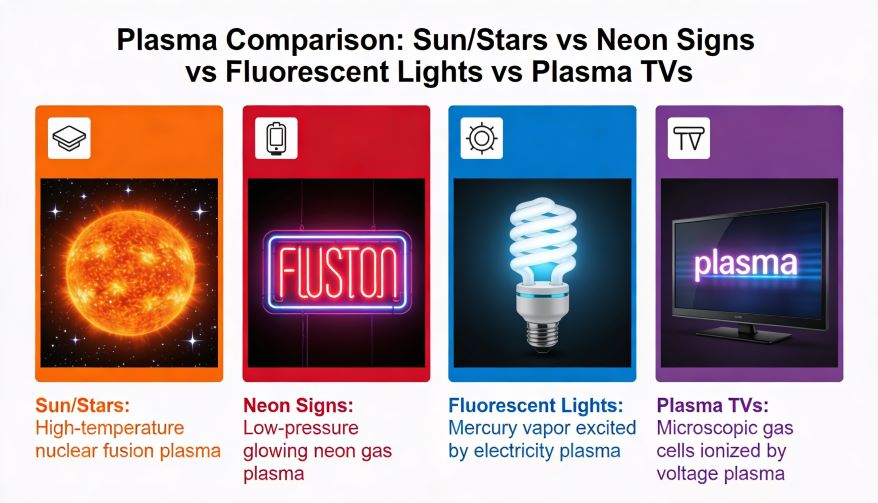
Neon signs use plasma to produce their bright colors. Electricity passes through gas trapped inside glass tubes. The gas ionizes and becomes plasma. Different gases create different colors when they become plasma. This technology has been used for over a century.
Fluorescent Lights
Fluorescent bulbs work using plasma technology. Mercury vapor inside the bulb becomes plasma when powered. The plasma emits ultraviolet light that excites the coating. As a result, the coating produces visible white light. These bulbs are more efficient than traditional ones.
Plasma Television
Plasma TVs use tiny cells filled with noble gases. Electrical charges turn these gases into plasma. The plasma then excites phosphors to create colored light. Each pixel contains red, green, and blue subpixels. Although LCD technology replaced them, plasma TVs were revolutionary.
Advanced Applications of Plasma
Nuclear Fusion Research
Scientists study plasma in state of matter for fusion energy. Fusion could provide clean, unlimited energy for humanity. However, containing plasma at millions of degrees is challenging. Magnetic fields create special bottles to hold the plasma. This research continues at facilities worldwide.
Space Propulsion
Plasma engines can propel spacecraft more efficiently than rockets. These engines ionize fuel to create plasma thrust. They use less fuel for long-distance space travel. In due time, plasma propulsion may enable interstellar missions.
Industrial Applications
Industries use plasma for cutting and welding metals. Plasma torches can cut through thick steel easily. In addition, plasma helps clean surfaces and modify materials. Medical devices also use plasma for sterilization purposes.
Why Plasma Matters in State of Matter
Understanding plasma in state of matter is crucial for science. It helps explain how stars work and produce energy. At the present time, plasma research leads to new technologies. This knowledge connects physics, chemistry, and engineering beautifully.
By and large, plasma dominates the universe more than solids. Yet most people learn less about it in school. With this in mind, studying plasma opens exciting career opportunities. Fields like aerospace, energy, and materials science need plasma experts.
Comparing Plasma to Other States
Plasma differs from gases in several important ways. Gases consist of neutral atoms or molecules. Plasma contains charged particles that interact electromagnetically. To put it another way, plasma behaves collectively. Gases don’t conduct electricity, but plasma does excellently.
In contrast to liquids and solids, plasma has no definite shape or volume. However, magnetic fields can give plasma a contained shape. This makes plasma unique among all states of matter.
Additionally, to stay updated with the latest developments in STEM research, visit STEM Quiz.
Frequently Asked Questions
Plasma, therefore, is an ionized state of matter with charged particles moving freely.
Plasma, however, differs because particles are charged, unlike neutral gas particles usually.
Plasma exists, for instance, in stars, lightning, auroras, and the sun’s atmosphere.
Plasma conducts electricity since, moreover, it contains free-moving ions and electrons everywhere.
Gases, therefore, turn into plasma when energy increases and particles become ionized.
Plasma is used, for instance, in neon lights, televisions, welding, and medical tools.
References
Megalecture. (2021). Chapter 5: States of matter [PDF]. https://megalecture.com/wp-content/uploads/2021/05/Chapter-5_-States-of-Matter.pdf
- About the Author
- Latest Posts

I am an inspirational writer and emerging science blogger with a deep-rooted passion for understanding and sharing the wonders of the world around us. My journey began with a Bachelor of Science in Chemistry from AKI’s Poona College of Arts, Commerce and Science, where I developed not only a strong foundation in scientific principles but also a mindset that values curiosity, observation, and critical thinking. Studying chemistry has taught me to approach problems with logic, to look beyond the obvious, and to see patterns where others might only see complexity. These experiences have shaped the way I perceive life and influence the way I express my thoughts, both scientifically and creatively.
I have always believed that knowledge is only as powerful as the way it is shared. This belief has guided me to create content that bridges the gap between science and everyday life. I aim to simplify complex scientific ideas so they become approachable, relatable, and engaging for everyone—whether someone has a formal background in science or is simply curious about the world. Science, in my view, is not confined to textbooks and laboratories; it is a way of thinking, understanding, and connecting with the world around us. By making science accessible, I hope to inspire curiosity, ignite learning, and encourage people to see the beauty and relevance of scientific discovery in their daily lives.
Alongside my love for science, I am deeply passionate about motivational writing. I believe words carry the power to transform perspectives, encourage self-reflection, and inspire action. By combining analytical thinking with creativity, I create content that is intellectually stimulating yet emotionally resonant. Whether I am breaking down a chemical concept, exploring a scientific phenomenon, or crafting motivational narratives, my goal is to communicate ideas in a way that is clear, meaningful, and impactful.
Through my work, I strive to empower my readers—not just by helping them understand the science around them, but by inspiring them to grow, learn, and realize their full potential. Every article, post, or story I write reflects my commitment to turning knowledge into inspiration. I want to spark curiosity, encourage self-improvement, and show that learning and personal growth are deeply connected. For me, writing is not just a craft; it is a way to touch minds, connect hearts, and make ideas come alive in a way that truly resonates.