Estimated reading time: 11 minutes
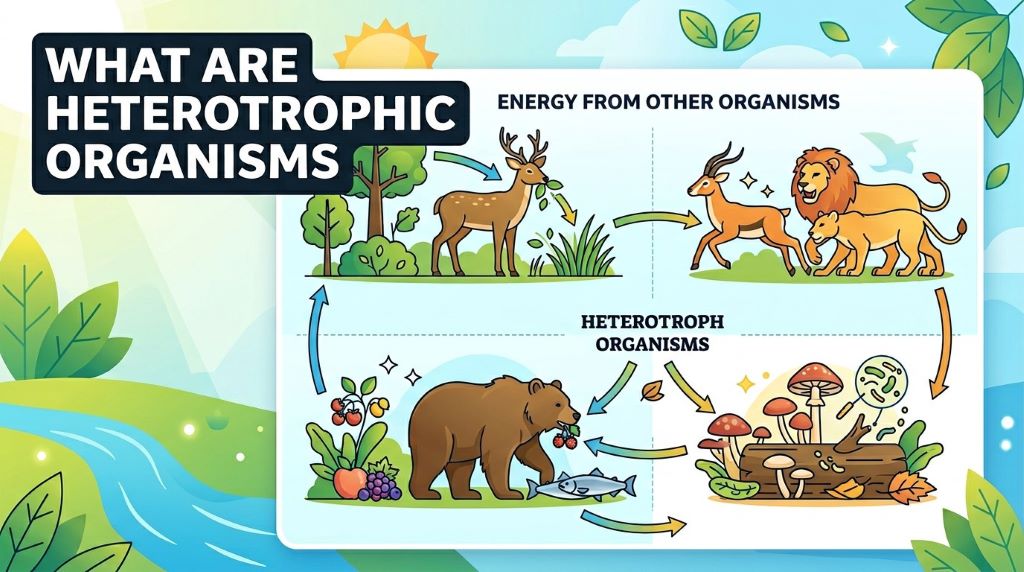
What Are Heterotrophic Organisms can be understood through how life uses energy to grow and survive. Generally, all organisms need food to get energy for life processes. In fact, some organisms make their own food, while others depend on external sources. Simply, those that rely on other living things for food are called heterotrophic organisms. In essence, they obtain energy by consuming plants or other animals. Everyday understanding says that, they play an important role in keeping natural ecosystems balanced and supporting life systems.
TL;DR’ What are Heterotrophic Organisms’
Heterotrophs are living things that cannot make their own food. In fact, they need plants or animals for energy. Because of this, they are called consumers. In other words, they eat other living things to live. Food chains shows that energy moves up. In the end, they help keep nature in balance.
Key Takeaways
- Heterotrophs cannot make their own food.
- They get energy from other living things.
- They are called consumers.
- Animals, fungi, and some bacteria are heterotrophs.
- They eat plants, animals, or both.
- Herbivores eat only plants.
- Carnivores eat only animals.
- Omnivores eat both.
- Decomposers break down dead things.
- They put nutrients back in the soil.
- This helps plants grow.
- Heterotrophs help the food chain.
- They keep nature in balance.
- Humans are heterotrophs too.
- We eat plants and animals.
- We do not make our own food.
- Heterotrophs matter for all life on Earth.
What Are Heterotrophic Organisms
“In nature, nothing lives alone—every organism depends on another“
Heterotrophs cannot make their own food. In fact, they eat plants or animals. They get energy from food. In other words, they need other living things to survive. Because of this, they are called consumers. In the end, energy flow depends on them.
If a student wants to learn about consumers, they should start with one question. What are heterotrophs? This builds a clear base. It connects with real life. It helps students see how ecosystems work.
Types of Heterotrophs
Heterotrophs have different types. In this case, to understand what are heterotrophic organisms, we look at their food habits. Herbivores eat plants. Carnivores eat animals. Omnivores eat both plants and animals. Decomposers break down dead matter. In other words, each type has a clear function. All things considered, these roles help keep ecosystems balanced.
Table 1: Types of Heterotrophic Organisms
| Type | Food Source | Example | Role in Ecosystem |
|---|---|---|---|
| Herbivores | Plants | Cow, Deer | Primary consumers |
| Carnivores | Animals | Lion, Tiger | Secondary/tertiary consumers |
| Omnivores | Plants and animals | Human, Bear | Flexible consumers |
| Decomposers | Dead plants and animals | Fungi, Bacteria | Nutrient recycling |
| Parasites | Living host organisms | Tapeworm | Depend on host for food |
Feeding Methods in Heterotrophs
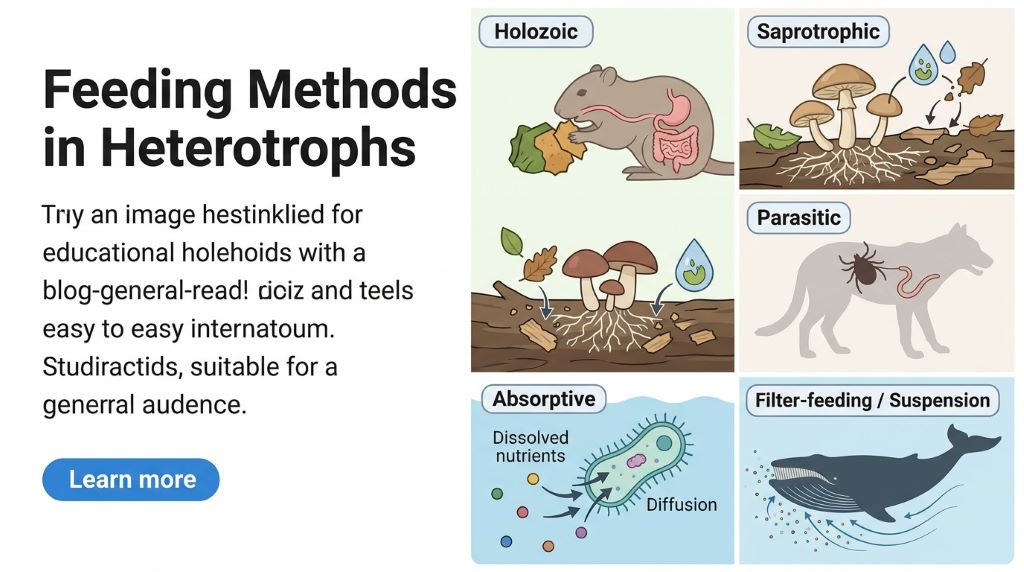
Heterotrophic organisms are living things that depend on other organisms for food. In many cases, they cannot produce their own food. As a result, they use different feeding methods. Some organisms eat solid food, while others take in dissolved nutrients. In many situations, their feeding style changes with the environment. On the other hand, some live freely, while others rely on a host. For this reason, these methods support survival in many conditions. In most animals, holozoic nutrition is common. In this process, food is taken in, digested inside the body, and then absorbed. Additionally, structures like teeth help break food, and the digestive system processes it.
What are heterotrophic organisms? They are living things that depend on other organisms for food. In contrast, many of them use saprotrophic nutrition. This is common in fungi and some bacteria. Instead of taking food in, they release enzymes onto dead matter. Because of this, complex substances break into simple forms. In many cases, these become glucose or amino acids. The organism then takes in these nutrients through its surface. In this way, saprotrophic feeding helps them get energy from dead material.
What are heterotrophic organisms? They are living things that cannot make their own food. In fact, they depend on other living things for food. In contrast, parasitic nutrition is another method used by many heterotrophs. Many cases shows that, a parasite lives on or inside a host. Instead of killing the host fast, it keeps it alive. Because of this, it slowly takes nutrients from the host. In the end, the host may get weak or sick over time.
Role in Ecosystems
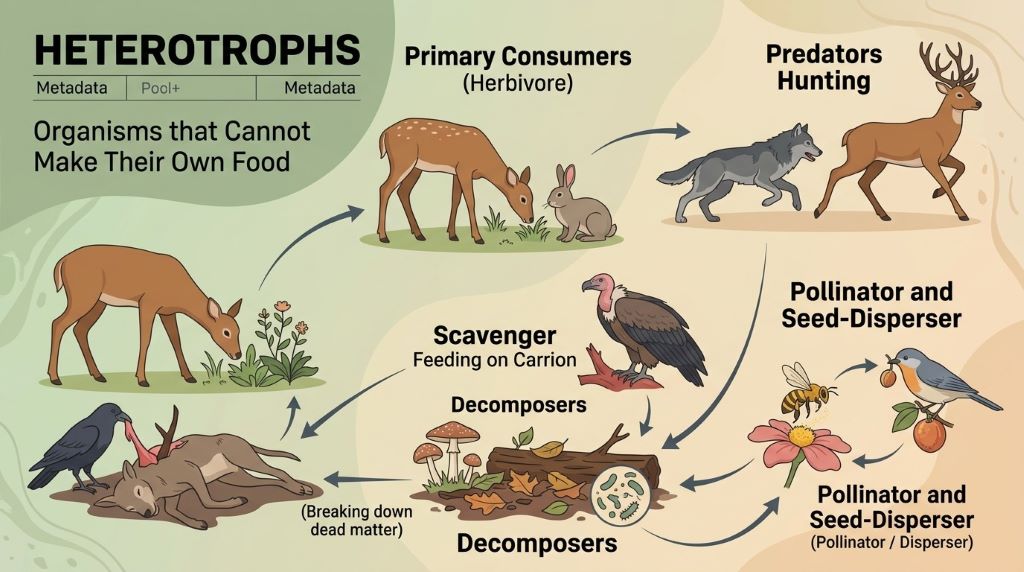
Heterotrophs cannot make their own food. In fact, they depend on other living things for energy. In ecosystems, they act as consumers. Because of this, they link plants to higher levels of the food chain. Since they cannot make food, they eat plants or animals. In other words, they get energy from food. In many cases, this feeding helps control the number of plants and animals. Finally, it stops too much growth and lack of food. Through eating and hunting, they keep energy moving in the ecosystem.
Heterotrophs also play a key role in recycling nutrients in nature. In particular, fungi and bacteria act as decomposers. In many cases, they break down dead plants, animals, and waste materials. Consequently, large and complex substances are converted into simple nutrients like nitrogen and phosphorus.
Heterotrophs also help keep ecosystems stable. For example, many animals help plants grow and spread. In this way, they help plants reproduce. In many cases, predators control the number of plant eaters. Because of this, they stop too much grazing and protect habitats. In the end, soil and plants stay healthy. In short, heterotrophs help keep nature in balance.
A study published in m Systems (2022) in American Society for Microbiology explored how marine heterotrophic bacteria use different metabolic strategies to survive and process organic matter in ocean ecosystems. The research showed that these bacteria are not all the same; instead, they have diverse nutritional needs and unique metabolic abilities.
Classification of Heterotrophic Organisms
Table 2: Categories of Heterotrophic Organisms and Feeding Methods
| Category | Feeding Method | Source of Nutrients | Common Examples |
| Holozoic | Ingestion of solid or liquid organic food followed by internal digestion. | Plants, animals, or both. | Humans, lions, amoebas, birds. |
| Saprotrophic | Extracellular digestion; secreting enzymes onto dead matter and absorbing nutrients. | Decaying plants, carcasses, or organic waste. | Mushrooms, bread mold, many soil bacteria. |
| Parasitic | Deriving nutrients directly from a living host, often causing harm. | Living tissue, blood, or pre-digested food of a host. | Tapeworms, leeches, ticks, Plasmodium. |
| Mixotrophic | Can alternate between autotrophy and heterotrophy depending on conditions. | Sunlight (photosynthesis) or organic prey. | Euglena, certain types of plankton. |
Examples of Heterotrophic Organisms
The animal kingdom provides the most prominent examples of heterotrophic organisms, ranging from microscopic zooplankton to the largest mammals. Vertebrates such as lions, elephants, and humans are classic holozoic heterotrophs, meaning they must ingest solid organic matter to survive. For instance, a lion serves as a top-tier carnivore by consuming the meat of herbivores, while a cow acts as a primary consumer by grazing on grass. Even within aquatic environments, creatures like the blue whale filter massive amounts of krill from the water, demonstrating how heterotrophs adapt their feeding mechanisms to suit their specific ecological niches.
Beyond the animal kingdom, fungi and certain types of bacteria represent a massive group of saprotrophic heterotrophs essential for life on Earth. Common mushrooms, molds, and yeasts do not “eat” in the traditional sense; instead, they grow on organic substrates like fallen logs, leaf litter, or even discarded food. By secreting enzymes that break down these complex materials, they recycle nutrients back into the soil. Additionally, parasitic heterotrophs like the Rafflesia flower or various disease-causing bacteria survive by siphoning energy directly from living hosts, illustrating the diverse and sometimes aggressive strategies heterotrophs use to acquire the carbon they cannot produce themselves.
Food Chain Importance

The food chain is the basic system that shows how energy and nutrients move through an ecosystem. In simple terms, it explains who eats whom. In this system, heterotrophic organisms cannot make their own food. Instead, they depend on other organisms for energy, which keeps the flow of energy moving in nature. For this reason, they depend completely on the food chain for survival.
“Heterotrophs keep energy moving through the food chain”
In many cases, the food chain is more than just a concept for them. Instead, it works as their main way to get energy. Through feeding relationships, they obtain nutrients from plants or other animals. Consequently, this flow of energy supports their life processes. In this way, the food chain becomes essential for the survival of all heterotrophs.
Here are the key reasons why the food chain is vital for heterotrophs:
1. The Gateway to Energy Acquisition
Since heterotrophs cannot capture sunlight to create glucose, they are entirely dependent on the “producers” (autotrophs) at the base of the food chain. The food chain works like a delivery system that moves energy through nature. In simple terms, plants first change sunlight into food energy. Next, this energy is passed to heterotrophs, who cannot make their own food. In this way, energy becomes usable and can be digested by different living organisms.. Whether a heterotroph is a primary consumer (eating plants) or a tertiary consumer (eating other predators), its existence depends on the successful transfer of calories through these linked levels.
2. Regulation of Population and Biodiversity
The food chain acts as a natural system of “checks and balances.” For heterotrophs, being part of a food chain means their populations are regulated by both their food sources (bottom-up control) and their predators (top-down control). This prevents any single species from over-consuming its resources. For example, if a predator is removed from a food chain, the herbivore population may explode, leading to overgrazing and the eventual collapse of the local environment, which would ultimately starve the herbivores themselves.
3. Concentration and Recycling of Nutrients
Food chains ensure that essential minerals and vitamins are concentrated as they move upward. Furthermore, the “end” of the food chain involving decomposers (saprotrophic heterotrophs) is crucial. These organisms break down the remains of other heterotrophs, releasing nitrogen and phosphorus back into the soil. For the heterotrophic community, this recycling is vital because it sustains the growth of the plants that will eventually become their next meal, creating a continuous loop of life.
To explain their role:
- Plants make food
- Herbivores eat plants
- Carnivores eat animals
- Decomposers break down waste
This chain supports life. In short, heterotrophs keep energy moving. A short thought helps here. Students often see food chains in books. However, real life depends on them. This makes biology useful.
Conclusion
In conclusion, heterotrophic organisms are living things that cannot make their own food. Instead, they depend on other organisms for energy and nutrients. In ecosystems, they act as consumers and play a big role in food chains. Because of this, they help move energy from plants to animals at higher levels.
In simple terms, heterotrophs are essential for keeping nature balanced. They support the flow of energy in food webs. By feeding on plants or other animals. In the end, this continuous process helps maintain stable and healthy ecosystems.
To test you knowledge check, STEM-Quiz.
Frequently Asked Questions
Heterotrophic organisms are living things that cannot make their own food. In simple terms, they depend on other organisms such as plants or animals for energy. As a result, they are known as consumers in ecosystems. In addition, they help transfer energy from producers to other levels in the food chain. In short, heterotrophs play an important role in keeping nature balanced and supporting life in ecosystems.
Heterotrophic organisms are important because they help keep ecosystems balanced and stable. In simple terms, they cannot make their own food, so they depend on plants and other organisms for energy. In this way, they act as consumers and help move energy through the food chain from one level to another.
Heterotrophs get food by depending on other living organisms for energy and nutrients. In simple terms, they cannot produce their own food, so they must obtain it from external sources. For example, herbivores eat plants, while carnivores feed on other animals.
Heterotrophs do not produce their own food or oxygen. Instead, they depend on other living organisms such as plants and animals for energy and nutrition. In simple terms, they cannot carry out photosynthesis, so they cannot make food from sunlight. Because of this, they must consume organic matter to survive.
Reference
Forchielli, E., Sher, D., & Segrè, D. (2022). Metabolic Phenotyping of Marine Heterotrophs on Refactored Media Reveals Diverse Metabolic Adaptations and Lifestyle Strategies. mSystems, 7(4), e0007022. https://doi.org/10.1128/msystems.00070-22
- About the Author
- Latest Posts

I hold an M.Sc. from the University of Allahabad, with a specialization in molecular biology, microbiology, and genetics. My academic training has provided me with a strong foundation in life sciences and research-based learning. Alongside my studies, I have gained valuable professional experience in both education and social development.
I worked at A.M. Oxford Public School, where I guided students toward academic success and encouraged curiosity and critical thinking. This role helped me develop effective teaching methods and strong communication skills. In addition, I contributed to the Jeevan Jagriti Foundation, where I actively participated in community programs focused on improving educational access and awareness among underprivileged groups.
Through these experiences, I built important interpersonal, leadership, and organizational skills. Working in diverse environments allowed me to understand both classroom dynamics and real-world social challenges. I remain committed to using my knowledge and skills to support education, promote scientific understanding, and contribute to meaningful community development initiatives.