Estimated reading time: 7 minutes
Liquids are everywhere in our daily lives. Water, juice, and milk are common liquid examples. Understanding liquid in state of matter helps you learn chemistry better. Liquids have unique properties that set them apart. They behave differently from solids and gases. Let’s explore this fascinating state of matter together.
Key Takeaway
- All things considered, liquids are matter’s flowing state. They have definite volume but variable shape always.
- Particles in liquids can slide past each other freely.
- Above all, liquids balance between solid and gas properties.
- Important characteristics include fluidity, viscosity, and surface tension.
- In conclusion, understanding liquid in state of matter enhances chemistry knowledge.
- It connects to real-world materials and natural phenomena.
- This foundational concept leads to advanced studies later on.
What Is Liquid in State of Matter?
A liquid is matter with definite volume but no shape. Particles in liquids stay close together like in solids. However, these particles can slide and move past each other. As a result, liquids flow and take container shapes. To illustrate, water poured into a glass becomes glass-shaped.
“Liquids have definite volume but no fixed shape, as particles are close together yet can slide past each other, allowing the liquid to take the shape of its container.”
The particles move freely within the fixed volume space. This movement gives liquids their characteristic flowing behavior.
Key Properties of Liquid in State of Matter
Definite Volume, No Definite Shape
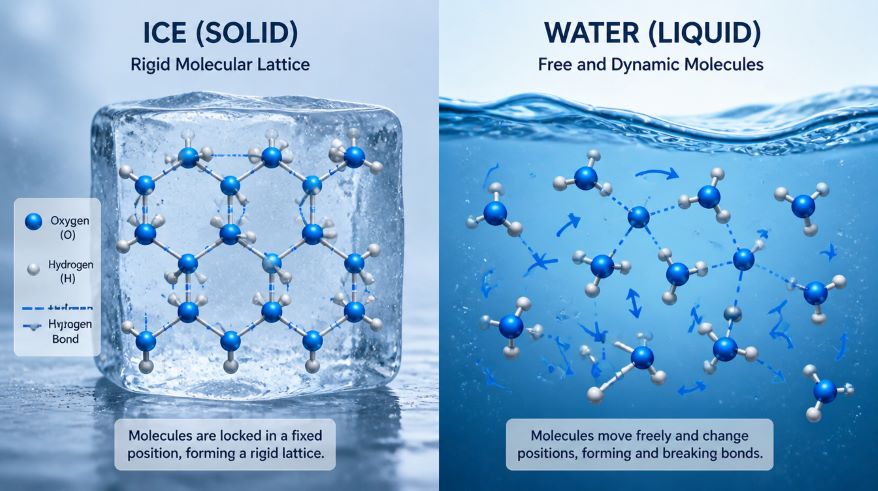
Liquids maintain a fixed volume regardless of the container. You cannot change the amount of liquid by changing containers. At the same time, liquids adapt to any container shape. Pour water into different containers and observe this property. The volume stays constant, but the shape always changes.
Ability to Flow
The most obvious property is that liquids can flow freely. This property is called fluidity. Particles slide past one another continuously throughout the liquid. To explain further, weak forces allow this sliding movement. You can pour liquids from one place to another. This flowing makes liquids useful for drinking and washing.
High Density
Liquids have relatively high density compared to gases. The particles remain close together with little empty space. In fact, liquid density is closer to solids than gases. This explains why liquids feel heavier than air. Water weighs much more than the same volume of air.
Incompressibility
Liquids are very difficult to compress into smaller volumes. The particles are already packed closely with minimal spacing. To put it differently, you can’t squeeze liquids much smaller. This property makes hydraulic systems work effectively in machines.
Particle Arrangement in Liquid State
Close But Mobile
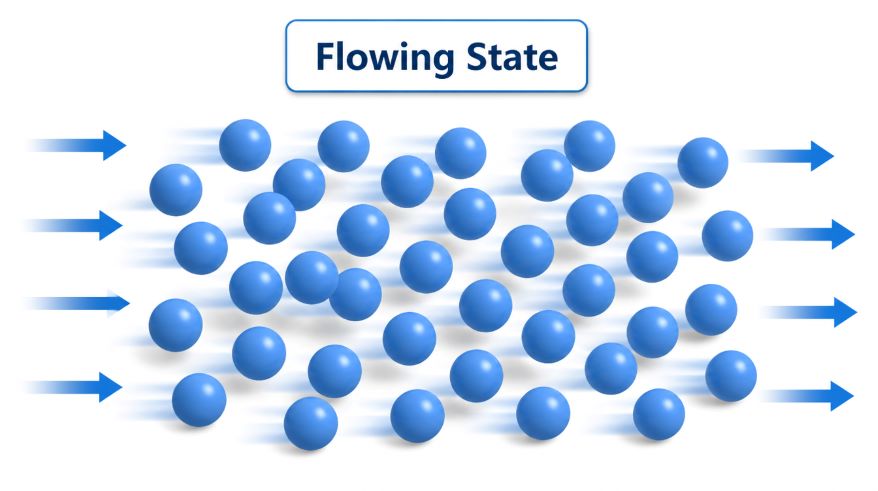
Particles in liquid in state of matter stay close together. They touch their neighboring particles most of the time. However, they’re not locked in fixed positions like solids. Instead, particles can roll and slide around each other. This arrangement creates the liquid’s unique properties.
Intermolecular Forces
Intermolecular forces in liquids are weaker than in solids. These forces still keep particles close together in contact. At the same time, forces allow particles to move around. In essence, liquids balance between solid rigidity and gas freedom. The forces are strong enough to maintain volume.
Random Movement
Particles in liquids move in random, unpredictable directions. They constantly change positions relative to their neighbors. This movement is faster than in solids but slower than in gases. As can be seen, liquids have medium particle speeds.
How Temperature Affects Liquid in State of Matter
Boiling Point
Every liquid has a specific boiling point temperature. At this temperature, liquids transform into gaseous state. Particles gain enough energy to escape into the air. Water boils at 100°C at sea level pressure. Different liquids have different boiling points entirely.
Freezing Point
Liquids freeze when cooled below their freezing point. The particles slow down and lock into fixed positions. As a result, the liquid becomes a solid state. Water freezes at 0°C and becomes ice crystals. This transformation removes the liquid’s flowing ability.
Effect of Heating
Heating a liquid makes particles move faster and more vigorously. The liquid may expand slightly due to increased motion. In addition, evaporation occurs faster at higher temperatures. Some particles gain enough energy to escape the surface.
Viscosity in Liquid State
What Is Viscosity?
Viscosity measures how easily a liquid flows. Thick liquids like honey have high viscosity values. Thin liquids like water have low viscosity instead. To illustrate, honey pours slowly while water flows quickly. Temperature affects viscosity significantly in most liquids.
Factors Affecting Viscosity
Several factors influence liquid viscosity in different ways. Stronger intermolecular forces create higher viscosity in the liquid. Larger molecules generally produce more viscous liquids too. Temperature plays a crucial role in viscosity changes. Heating usually decreases viscosity and makes liquids flow easier.
Surface Tension in Liquids
Understanding Surface Tension
Surface tension makes liquid surfaces behave like stretched skin. Particles at the surface experience unbalanced forces pulling inward. This creates a “skin” effect on the liquid surface. Water droplets form spheres because of surface tension. Insects can walk on water due to this property.
Practical Examples
Surface tension affects many everyday phenomena you observe. Water forms droplets on leaves instead of spreading flat. Soap bubbles exist because of surface tension forces. In similar fashion, capillary action uses surface tension effects. Plants transport water upward through thin tubes using this.
Real-World Examples of Liquid in State of Matter
Water
Water is the most important liquid on Earth. It covers about 70% of our planet’s surface. All living things need water to survive and function. Water exists in oceans, rivers, lakes, and rain. It’s essential for drinking, cooking, and cleaning daily.
Oils
Cooking oils are common liquids used in food preparation. Olive oil, vegetable oil, and sunflower oil are examples. These liquids don’t mix with water due to differences. Oils float on water because they’re less dense.
Beverages
Juices, sodas, and milk are familiar liquid beverages. These liquids contain dissolved substances and nutrients throughout. They flow easily and take the shape of glasses. Beverages demonstrate liquid properties you experience every single day.
Mercury
Mercury is the only metal that’s liquid at room temperature. It has very high density compared to water. Mercury was used in thermometers for many years. However, it’s toxic and requires careful handling always.
Diffusion in Liquid in State of Matter
Diffusion is the spreading of particles throughout a liquid. Drop food coloring into water and watch it spread. Particles move from high concentration to low concentration areas. This process happens faster in liquids than in solids. However, diffusion in liquids is slower than in gases.
Why Understanding Liquid State Matters
Learning about liquid in state of matter is crucial knowledge. It helps explain weather patterns like rain and clouds. At the present time, many technologies depend on liquid properties. Scientists use this knowledge in chemistry, biology, and engineering.
By and large, liquids enable life on Earth to exist. They transport nutrients in plants and animals efficiently. With this in mind, studying liquids opens career opportunities. Fields like chemistry, medicine, and environmental science need experts.
Comparing Liquids to Other States
Liquids exist between solids and gases in many ways. Solids have fixed shape and volume without any flow. Gases have neither definite shape nor definite volume. To sum up, liquids represent a middle state. They maintain volume while allowing free flow and movement.
In contrast to solids, liquids have weaker intermolecular forces. Compared to gases, liquids have much higher density. This positioning makes liquids uniquely useful for many applications.
Also Read: Introduction to Solid in State of Matter: First State of matter
Frequently Asked Questions
A liquid has fixed volume but no fixed shape in containers.
Liquid particles, moreover, stay close together but move freely around each other.
Liquids, therefore, flow easily and adapt shape because particles are not fixed.
Liquids are slightly compressible; however, particles are closely packed compared to gases.
Common liquids include water, for instance, milk, oil, juice, and liquid soap.
Liquids, however, have fixed volume but lack definite shape unlike solids completely.
Temperature, therefore, increases particle motion, making liquids expand and flow faster easily.
Yes, liquids, moreover, can evaporate into gases or freeze into solids easily.
Reference
- Megalecture. (2021). Chapter 5: States of matter [PDF]. https://megalecture.com/wp-content/uploads/2021/05/Chapter-5_-States-of-Matter.pdf
- Bodo, E. (2021). Welcome to Liquids: An Open Access Journal. Liquids, 1(1), 75-76. https://doi.org/10.3390/liquids1010006
- About the Author
- Latest Posts

I am an inspirational writer and emerging science blogger with a deep-rooted passion for understanding and sharing the wonders of the world around us. My journey began with a Bachelor of Science in Chemistry from AKI’s Poona College of Arts, Commerce and Science, where I developed not only a strong foundation in scientific principles but also a mindset that values curiosity, observation, and critical thinking. Studying chemistry has taught me to approach problems with logic, to look beyond the obvious, and to see patterns where others might only see complexity. These experiences have shaped the way I perceive life and influence the way I express my thoughts, both scientifically and creatively.
I have always believed that knowledge is only as powerful as the way it is shared. This belief has guided me to create content that bridges the gap between science and everyday life. I aim to simplify complex scientific ideas so they become approachable, relatable, and engaging for everyone—whether someone has a formal background in science or is simply curious about the world. Science, in my view, is not confined to textbooks and laboratories; it is a way of thinking, understanding, and connecting with the world around us. By making science accessible, I hope to inspire curiosity, ignite learning, and encourage people to see the beauty and relevance of scientific discovery in their daily lives.
Alongside my love for science, I am deeply passionate about motivational writing. I believe words carry the power to transform perspectives, encourage self-reflection, and inspire action. By combining analytical thinking with creativity, I create content that is intellectually stimulating yet emotionally resonant. Whether I am breaking down a chemical concept, exploring a scientific phenomenon, or crafting motivational narratives, my goal is to communicate ideas in a way that is clear, meaningful, and impactful.
Through my work, I strive to empower my readers—not just by helping them understand the science around them, but by inspiring them to grow, learn, and realize their full potential. Every article, post, or story I write reflects my commitment to turning knowledge into inspiration. I want to spark curiosity, encourage self-improvement, and show that learning and personal growth are deeply connected. For me, writing is not just a craft; it is a way to touch minds, connect hearts, and make ideas come alive in a way that truly resonates.