Estimated reading time: 8 minutes
Gases surround us every moment of our lives. The air you breathe is actually a mixture of gases. Understanding gas in state of matter is essential for chemistry learning. Gases behave very differently from solids and liquids. They have unique properties that make them fascinating to study. Let’s explore this amazing state of matter together.
Key Takeaways
- All things considered, gases are matter’s most free-moving state.
- They have no definite shape or volume whatsoever.
- Particles in gases move rapidly in completely random directions.
- Above all, gases can be compressed easily into smaller spaces.
- Important properties include low density, high diffusion, and pressure exertion.
- In conclusion, understanding gas in state of matter enhances chemistry knowledge.
- It connects to weather, breathing, and countless technologies around us.
What Is Gas in State of Matter?
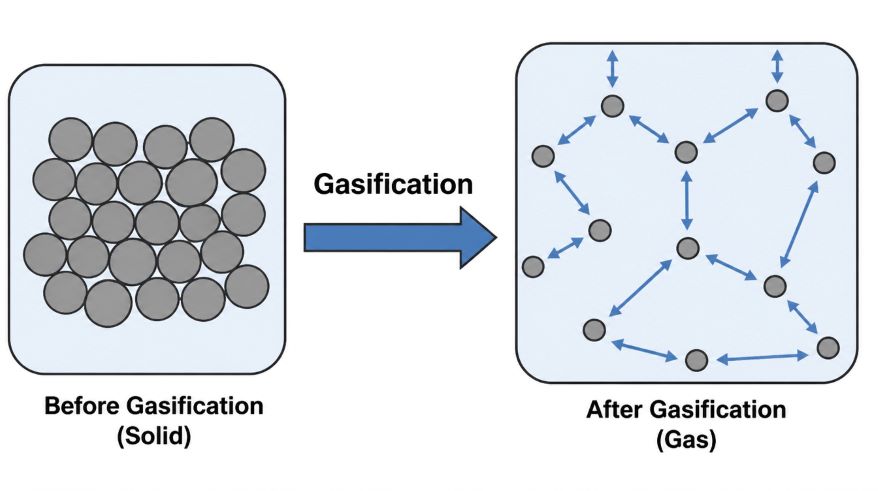
A gas is matter with no definite shape or volume. Particles in gases move freely in random, constant motion. Weak intermolecular forces allow this complete freedom of movement. As a result, gases expand to fill any available space. To illustrate, air fills an entire room from corner to corner.
“Gases have neither definite shape nor volume, as particles move freely in constant random motion with negligible intermolecular forces.“
The particles spread out as far as the container allows. This behavior makes gases the most energetic state of matter.
Key Properties of Gas in State of Matter
No Definite Shape or Volume
Gases lack both fixed shape and fixed volume. They take the shape of whatever container holds them. At the same time, gases expand to fill the entire space. Pour gas into a large container, and it spreads everywhere. This property distinguishes gases from liquids and solids completely.
High Compressibility
Gases are easily compressed into much smaller volumes. Large spaces exist between gas particles at all times. To explain further, you can squeeze gases into tiny spaces. This property makes gases useful for storage and transportation. Compressed air tanks demonstrate this property perfectly in real life.
Low Density
Gases have very low density compared to other states. Particles are spread far apart with lots of empty space. In fact, gas density is much lower than liquids. This explains why gases feel so light and weightless. Air seems to have almost no weight at all.
Rapid Diffusion
Gases diffuse extremely quickly through other gases or spaces. Particles move at high speeds in all possible directions. As a matter of fact, perfume scent spreads across rooms rapidly. This fast diffusion happens because particles rarely collide with others.
Exerts Pressure
Gases exert pressure equally in all directions on containers. Moving particles constantly collide with container walls everywhere. These collisions create the pressure we measure and observe. Tire pressure comes from billions of air particle collisions. The faster particles move, the higher the pressure becomes.
Particle Arrangement in Gas State

Wide Spacing
Particles in gas in state of matter are very far apart. The distance between particles is much larger than in liquids. To put it differently, gases are mostly empty space. Only a tiny fraction of gas volume contains actual particles. This spacing allows for easy compression of gas volumes.
Random, Rapid Motion
Gas particles move in completely random directions at high speeds. They travel in straight lines until hitting something else. After that, they bounce off and continue in new directions. This constant motion never stops in the gaseous state. Temperature determines how fast particles move around.
Negligible Intermolecular Forces
Intermolecular forces in gases are almost nonexistent or negligible. Particles are too far apart to attract each other significantly. In essence, gas particles behave as independent units completely. This independence gives gases their unique flowing and expanding properties.
How Temperature Affects Gas in State of Matter
Relationship with Pressure
Heating a gas makes its particles move much faster. Faster particles hit container walls more frequently and harder. As a result, pressure increases when temperature rises in gases. This relationship is described by important gas laws studied. Cooling gases reduces pressure by slowing particle movement down.
Volume Changes
Gas volume increases when temperature rises at constant pressure. Particles move faster and push outward more forcefully. Hot air balloons work because of this volume expansion principle. Conversely, cooling gases makes them contract into smaller volumes. This behavior follows predictable patterns scientists can measure accurately.
Condensation Point
Every gas can become liquid when cooled sufficiently below condensation temperature. Particles slow down and intermolecular forces become more significant. At the condensation point, gases transform into liquid state. Water vapor condenses into liquid water droplets on cold surfaces.
Gas Laws Governing Behavior
Boyle’s Law
Boyle’s Law states that pressure and volume are inversely related. When volume decreases, pressure increases proportionally in the gas. To illustrate, squeezing a syringe increases air pressure inside dramatically. This law applies when temperature stays constant throughout the process.
Charles’s Law
Charles’s Law describes the temperature-volume relationship in gases clearly. Volume increases proportionally when temperature rises at constant pressure. Balloons expand in warm weather and shrink in cold conditions. This law explains many everyday observations about gas behavior.
Avogadro’s Law
Avogadro’s Law states that volume depends on particle number. More gas particles create larger volumes at constant temperature and pressure. Equal volumes of gases contain equal numbers of particles. This principle helps chemists calculate amounts in chemical reactions.
Real-World Examples of Gas in State of Matter
Air We Breathe
Air is a mixture of several different gases combined. However, Nitrogen makes up about 78% of air by volume. Oxygen accounts for approximately 21% of the air mixture. Carbon dioxide, argon, and other gases form the remaining percentage. Moreover, We need this gas mixture to survive every moment.
Natural Gas
Natural gas is used for heating homes and cooking food. It consists mainly of methane molecules moving freely about. This gas burns cleanly and produces lots of useful heat. Many households depend on natural gas for energy daily.
Carbon Dioxide
Carbon dioxide is a colorless gas we exhale constantly. Additionally, Plants need this gas for photosynthesis and growth processes. It also exists in soda and carbonated beverages everywhere. Dry ice is solid carbon dioxide that sublimates directly.
Helium
Helium is a very light gas used in balloons. However, It’s less dense than air, so balloons float upward. Helium is also used in scientific equipment and research. This noble gas doesn’t react with other elements easily.
Practical Applications of Gases
Transportation
Compressed gases power many vehicles and transportation systems effectively. Natural gas buses run on compressed methane fuel efficiently. In addition, hydrogen fuel cells may power future vehicles. However, Gas engines convert fuel energy into motion through combustion.
Medical Uses
Oxygen gas is essential for patients with breathing difficulties. Anesthesia uses special gases to make surgery painless and safe. Hospitals store medical gases in pressurized tanks for quick access. However, These applications save countless lives every single day.
Industrial Processes
Industries use various gases in manufacturing as well as production processes. Welding requires gases like acetylene and oxygen for cutting metals. However, Food packaging uses nitrogen gas to preserve freshness longer. Chemical plants use gases as reactants in producing materials.
Why Understanding Gas State Matters
Learning about gas in state of matter is crucial knowledge. It explains weather patterns like wind and atmospheric pressure changes. At the present time, clean energy research focuses on gases. Scientists study greenhouse gases and their environmental effects extensively.
By and large, gases enable many modern technologies to function. They’re essential for transportation, industry, and medical care worldwide. With this in mind, studying gases opens exciting career paths. Fields like aerospace, environmental science, and engineering need gas experts.
Comparing Gases to Other States
Gases differ dramatically from solids and liquids in behavior. Solids have both definite shape and definite volume always. Liquids have definite volume but take container shapes easily. To sum up, gases are the freest state. They have the weakest intermolecular forces of all states.
In contrast to liquids, gases have much lower densities. Compared to solids, gases have enormous compressibility and freedom. This makes gases uniquely useful for countless applications daily.
Also Read: Introduction to Solid in State of Matter: First State of matter
Frequently Asked Questions
A gas is matter with no fixed shape or fixed volume.
Gas particles, moreover, move freely and quickly, filling the entire container space.
Gases are indeed compressible because, particles have large spaces between them.
Temperature increases particle motion, causing gases to expand and spread faster.
Common gases include oxygen, for instance, nitrogen, carbon dioxide, and water vapor.
Gases, however, differ because they lack definite shape, unlike solids and liquids.
Gases spread quickly moreover, particles move randomly and collide with each other.
Yes, gases, therefore, can condense into liquids when temperature decreases significantly.
Reference
- Megalecture. (2021). Chapter 5: States of matter [PDF]. https://megalecture.com/wp-content/uploads/2021/05/Chapter-5_-States-of-Matter.pdf
- Anthony, E. J. (2021). Gases—An Open Access Journal. Gases, 1(1), 51-52. https://doi.org/10.3390/gases1010004
- About the Author
- Latest Posts

I am an inspirational writer and emerging science blogger with a deep-rooted passion for understanding and sharing the wonders of the world around us. My journey began with a Bachelor of Science in Chemistry from AKI’s Poona College of Arts, Commerce and Science, where I developed not only a strong foundation in scientific principles but also a mindset that values curiosity, observation, and critical thinking. Studying chemistry has taught me to approach problems with logic, to look beyond the obvious, and to see patterns where others might only see complexity. These experiences have shaped the way I perceive life and influence the way I express my thoughts, both scientifically and creatively.
I have always believed that knowledge is only as powerful as the way it is shared. This belief has guided me to create content that bridges the gap between science and everyday life. I aim to simplify complex scientific ideas so they become approachable, relatable, and engaging for everyone—whether someone has a formal background in science or is simply curious about the world. Science, in my view, is not confined to textbooks and laboratories; it is a way of thinking, understanding, and connecting with the world around us. By making science accessible, I hope to inspire curiosity, ignite learning, and encourage people to see the beauty and relevance of scientific discovery in their daily lives.
Alongside my love for science, I am deeply passionate about motivational writing. I believe words carry the power to transform perspectives, encourage self-reflection, and inspire action. By combining analytical thinking with creativity, I create content that is intellectually stimulating yet emotionally resonant. Whether I am breaking down a chemical concept, exploring a scientific phenomenon, or crafting motivational narratives, my goal is to communicate ideas in a way that is clear, meaningful, and impactful.
Through my work, I strive to empower my readers—not just by helping them understand the science around them, but by inspiring them to grow, learn, and realize their full potential. Every article, post, or story I write reflects my commitment to turning knowledge into inspiration. I want to spark curiosity, encourage self-improvement, and show that learning and personal growth are deeply connected. For me, writing is not just a craft; it is a way to touch minds, connect hearts, and make ideas come alive in a way that truly resonates.