
Estimated reading time: 9 minutes
Life depends on how energy moves in nature. The topic of autotrophic vs heterotrophic organisms explains this clearly. In simple terms, some living things make their own food using sunlight or chemicals. On the other hand, some must depend on other organisms for food and energy. As a result, all ecosystems stay connected and active. With this in mind, life on Earth works like a continuous energy chain where each organism plays an important role.
Key Takeaways
- Autotrophs make their own food.
- They use light or simple chemicals.
- Heterotrophs eat other organisms for energy.
- They depend on plants or animals.
- Both move energy through nature.
- Energy flows from one to another.
- Ecosystems need both groups to work.
- Life cannot continue without this balance.
- Humans depend on both systems for survival.
- We eat food and rely on plants too.
What Are Autotrophic Organisms?
Autotrophic organisms make their own food. In other words, they turn sunlight or basic chemicals into energy-packed meals. This sets them apart from heterotrophic organisms, which get energy in different ways. Plants serve as the top example. They mix sunlight, water, and carbon dioxide to create food through photosynthesis. In turn, this process feeds nearly all life on Earth.
With attention to how nature works, autotrophs act as primary energy producers. They start the food chain by creating food inside their cells. As can be seen, without them, energy would not enter ecosystems. They also release oxygen during food production. This oxygen supports animals and humans for breathing and survival. In effect, autotrophs keep the balance of life stable.
To put it differently, autotrophic organisms are natural food makers. They do not depend on other organisms for energy. In contrast, heterotrophs depend on them directly or indirectly. This difference defines autotrophic vs heterotrophic organisms clearly in biology. With this in mind, autotrophs form the base of all food chains. So, they are essential for life continuity on Earth.
Simple Food Making in Terms of Autotrophic vs Heterotrophic Organisms
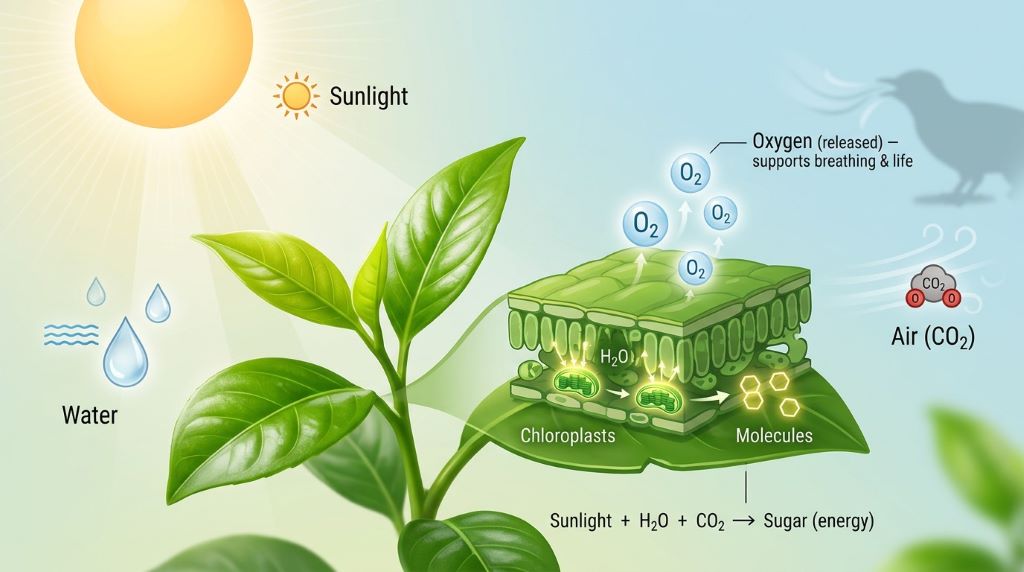
Plants take sunlight, water, and air to make food. They use leaves to turn these inputs into sugar. With attention to autotrophic vs heterotrophic organisms, plants are autotrophs that create their own energy source. So long as sunlight is available, they keep producing food. They also release oxygen into the air during this process. With this in mind, oxygen supports breathing and life on Earth.
Small Life in Dark Places: Autotrophic vs Heterotrophic Organisms
Some bacteria live in places without sunlight. They use chemicals as an energy source instead. With attention to autotrophic vs heterotrophic organisms, these bacteria are autotrophs that survive in extreme conditions. In contrast, most life depends on sunlight for energy. This happens deep in the oceans and underground areas. Even in darkness, life continues through chemical energy use.
What Are Heterotrophic Organisms?
Heterotrophic organisms are living things that cannot make their own food. They depend on plants or other animals for energy. With attention to autotrophic vs heterotrophic organisms, heterotrophs form the group that consumes food rather than producing it. Humans, animals, and many fungi belong to this group. They play a key role in energy movement through food chains.
In contrast, heterotrophs obtain energy by eating living or dead organisms. They break down food inside their bodies to release energy. With this in mind, they help transfer energy across ecosystems. They also support recycling of nutrients in nature. So, life depends on both producers and consumers working together.
Plant Eaters in Terms of Autotrophic vs Heterotrophic Organisms
Herbivores are animals that eat only plants. They get all their energy from plant material. With attention to autotrophic vs heterotrophic organisms, herbivores are heterotrophs because they depend on autotrophs like plants for food. Cows and goats are common examples in nature. This simple feeding link keeps energy moving in ecosystems.
In contrast, plants pass stored energy to herbivores. Herbivores digest this food and release energy for growth. With this in mind, they form an important step in food chains. So, energy flows from plants to animals in a clear path. This supports balance in nature and keeps life going smoothly..
Meat Eaters in Relation to Autotrophic vs Heterotrophic Organisms
Carnivores are animals that eat other animals. They get energy by hunting and consuming meat. With attention to autotrophic vs heterotrophic organisms, carnivores are heterotrophs because they depend on other living organisms for food. Lions and tigers are well-known examples in nature. They play a strong role in controlling ecosystem balance.
In contrast, carnivores help keep animal populations under control. They remove weak or sick animals from the system. With this in mind, energy continues to move through food chains. So, ecosystems stay stable through predator and prey balance. This shows how nature manages life in a simple and clear way.
Nature Recyclers
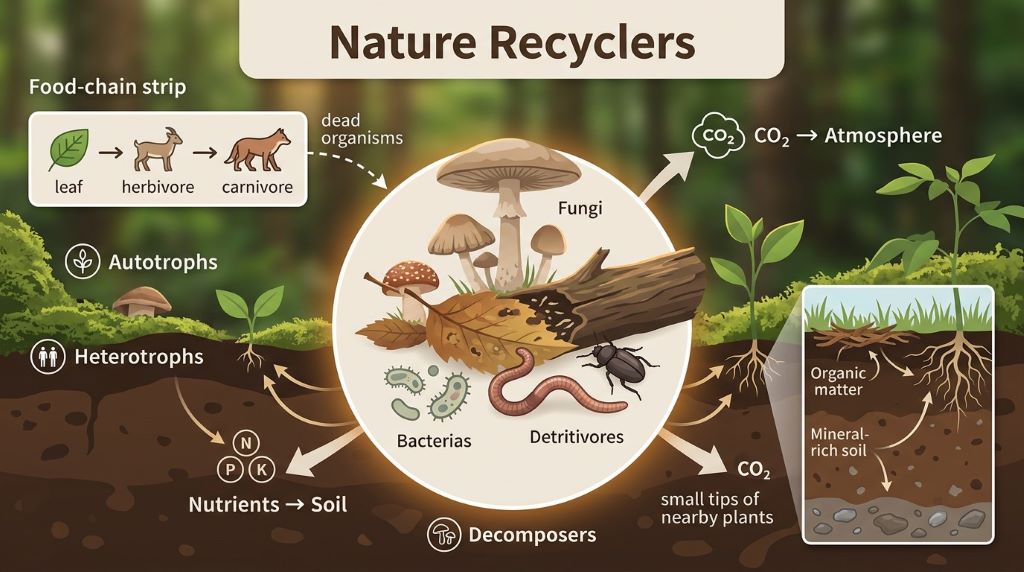
Decomposers break down dead plants and animals. For example, they use fungi and bacteria for this job. In the split between autotrophic and heterotrophic organisms, decomposers count as heterotrophs. In other words, they get energy from dead organic matter. They put nutrients back into the soil. As a result, soil gets rich for new plants to grow. In this cycle, nature recycles materials so life goes on..
Autotrophs vs Heterotrophs
Autotrophs vs Heterotrophs explain how living things get energy in nature. In autotrophic vs heterotrophic organisms, autotrophs make their own food using sunlight or chemicals. In contrast, heterotrophs depend on other organisms for food and energy.
To explain further, autotrophs act as producers in ecosystems. They start food chains by creating energy-rich food. Meanwhile, heterotrophs act as consumers in the same system. They eat plants, animals, or both to survive. So, energy flows from autotrophs to heterotrophs in nature. This simple system keeps ecosystems balanced and alive.
Generally, the study explains how energy moves between different living systems in the deep ocean, highlighting the connection between autotrophic vs heterotrophic organisms. In fact, autotrophs produce energy using chemicals or carbon sources, while heterotrophs depend on organic matter for survival and growth. In simple terms, energy flows from producers to consumers, supporting life in a clear and easy chain. Simply, both groups work together to keep marine ecosystems active and balanced.
Table 1: Autotrophs vs Heterotrophs
| Feature | Autotrophs | Heterotrophs |
| Definition | Organisms that produce their own food from inorganic sources. | Organisms that cannot produce their own food and must consume other organic matter. |
| Energy Source | Sunlight (Photosynthesis) or chemical reactions (Chemosynthesis). | Consuming plants, animals, or decomposing matter. |
| Position in Food Chain | Primary Producers (Level 1). | Consumers (Levels 2, 3, and 4). |
| Carbon Source | They fix carbon dioxide ($CO_2$) from the atmosphere. | They obtain carbon by eating autotrophs or other heterotrophs. |
| Examples | Plants, algae, and some bacteria (cyanobacteria). | Humans, animals, fungi, and most bacteria. |
Energy Flow in Autotrophic vs Heterotrophic Organisms
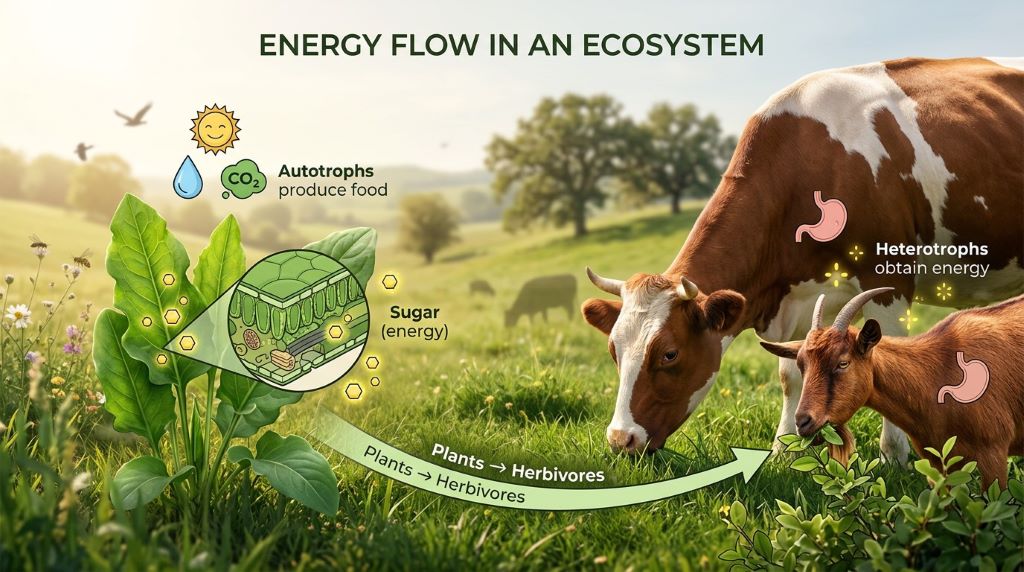
Plants start the energy chain in nature by producing food through sunlight. Animals pass this energy forward by eating plants or other animals. In autotrophic vs heterotrophic organisms, plants are autotrophs while animals are heterotrophs in the same system. Without plants, energy flow in ecosystems would stop completely. In contrast, both groups depend on each other to keep life stable. So, nature works through a simple but strong energy connection.
Simple Balance with Autotrophic vs Heterotrophic Organisms
Nature works like a cycle where energy keeps moving. Each organism depends on another for survival. Autotrophic vs heterotrophic organisms explains how energy starts and moves in life systems. Autotrophs make food, while heterotrophs use it. So, ecosystems stay active and balanced. Everything in nature stays linked through simple energy flow.
.
Real Life Uses
These ideas are not just theory. In daily life, science uses them in many ways. Farmers depend on plant growth to produce food for people. This helps supply crops and supports agriculture systems. In the same way, doctors study bacteria and microbes to understand disease and health. This helps in treatment and prevention of infections. With this in mind, science becomes useful in real life. So, these biological ideas guide farming, medicine, and research every day.
Environment
Scientists study air and soil to understand how nature works. They also observe how energy moves through living systems. Autotrophic vs heterotrophic organisms, explain how autotrophs produce energy and heterotrophs use it. In this process, they track how energy flows through ecosystems. So, plants, animals, and microbes all stay connected through this energy system. With this in mind, such research helps protect air, water, and soil for all life
Technology
Some bacteria can produce clean energy from natural processes. Scientists study these organisms in laboratories and field research. With attention to environmental biotechnology, they use microbes to develop better energy systems. In contrast to traditional fuels, this method reduces pollution and waste. So, new energy sources can be created from living systems in a safer way. With this in mind, green science is growing quickly and shaping future technology.
Autotroph Facts
To list key points:
- Make their own food
- Use sunlight or chemicals
- Start food chains
- Produce oxygen
Autotrophs support all life systems. They are basic life builders.
Heterotroph Facts
To list simple facts:
- Eat plants or animals
- Cannot make food
- Help energy flow
- Recycle nutrients
Heterotrophs depend on other life.
They keep ecosystems active.
Conclusion
All things considered, autotrophs and heterotrophs work as a team in nature. Autotrophs make food using sunlight. Heterotrophs eat that food for energy.
Together, they keep all ecosystems alive. One group cannot exist without the other. Energy always moves from one to another. No food chain works without both groups. A plant often starts the food you eat. Life on Earth is one simple energy loop.
To test your knowledge check out STEM-Quiz
Frequently Asked Questions
Autotrophs are living organisms that make their own food using sunlight or chemicals. In simple terms, they act as producers in nature and start energy flow. With attention to autotrophic vs heterotrophic organisms, autotrophs differ because they do not depend on other organisms for food.
Heterotrophs are organisms that cannot make their own food. They depend on plants or other animals for energy and survival. In autotrophic vs heterotrophic organisms, heterotrophs are consumers that get food from other living things in nature.
Humans are heterotrophs because they cannot make their own food. They depend on plants and animals for energy and survival.
In autotrophic vs heterotrophic organisms, humans belong to the heterotroph group that gets food from other living organisms in nature.
Reference
Srivastava, A., De Corte, D., Garcia, J.A.L. et al. Interplay between autotrophic and heterotrophic prokaryotic metabolism in the bathy pelagic realm revealed by metatranscriptomic analyses. Microbiome 11, 239 (2023). https://doi.org/10.1186/s40168-023-01688-7
- About the Author
- Latest Posts

I hold an M.Sc. from the University of Allahabad, with a specialization in molecular biology, microbiology, and genetics. My academic training has provided me with a strong foundation in life sciences and research-based learning. Alongside my studies, I have gained valuable professional experience in both education and social development.
I worked at A.M. Oxford Public School, where I guided students toward academic success and encouraged curiosity and critical thinking. This role helped me develop effective teaching methods and strong communication skills. In addition, I contributed to the Jeevan Jagriti Foundation, where I actively participated in community programs focused on improving educational access and awareness among underprivileged groups.
Through these experiences, I built important interpersonal, leadership, and organizational skills. Working in diverse environments allowed me to understand both classroom dynamics and real-world social challenges. I remain committed to using my knowledge and skills to support education, promote scientific understanding, and contribute to meaningful community development initiatives.