
Estimated reading time: 8 minutes
Modes of Nutrition (Autotrophic & Heterotrophic) explain how all living things get the energy they need to live. Some organisms make their own food using sunlight or simple chemicals. These are called autotrophs. Others cannot make food on their own. They eat plants, animals, or both, and are called heterotrophs. Together, these two modes of nutrition keep energy moving through nature and help life continue on Earth. A study in Functional Ecology (2007) shows that Modes of Nutrition and environmental factors affect how living things grow and survive. In simple terms, nutrients and conditions shape how organisms get energy and live. This means that when the environment changes, the way organisms feed and respond also changes.
Key Takeaways
- Autotrophs make their own food using sunlight or simple chemicals.
- Heterotrophs get energy by eating plants, animals, or organic matter.
- Photosynthesis is the main way autotrophs produce food on Earth.
- Heterotrophic nutrition has three types: holozoic, saprophytic, and parasitic.
- Both modes support real-world work in biotech, medicine, and environmental science.
What Is Autotrophic Nutrition?
Modes of Nutrition (Autotrophic & Heterotrophic) show how life gets energy to survive. Autotrophic nutrition is the way some organisms make their own food. They use simple things like water and carbon dioxide. With sunlight or chemical energy, they turn these into food they can use.
Photosynthesis is the main process in autotrophic nutrition. Each year, it changes about 200 billion tonnes of carbon dioxide into organic matter. It also releases about 140 billion tonnes of oxygen into the air. In simple terms, the oxygen we breathe comes from these autotrophic organisms.
Two Types of Autotrophic Nutrition
Prior to diving deeper, it helps to know the two main types.
- Photoautotrophic nutrition — organisms use sunlight as energy. Green plants, algae, and cyanobacteria are examples.
- Chemoautotrophic nutrition — organisms use chemical reactions as energy. Deep-sea bacteria near hydrothermal vents use this method.
In Modes of Nutrition (Autotrophic & Heterotrophic), chemoautotrophs show a unique way life can survive. They live and grow in places where sunlight does not reach. They use energy from chemicals instead of light. This proves that life can exist in extreme environments. It also helps scientists study life beyond Earth and supports future space exploration.
How Photosynthesis Actually Works
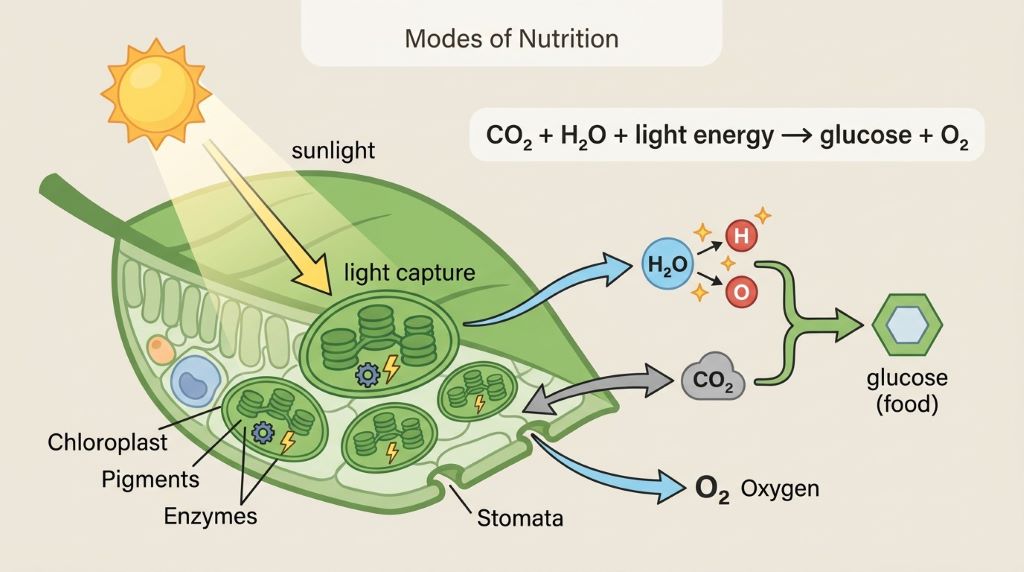
In Modes of Nutrition (Autotrophic & Heterotrophic), photosynthesis is a simple but powerful process. It uses energy from sunlight to make food. Special parts inside cells, such as pigments and enzymes, help capture light and change it into usable energy. These parts work together in a clear and organized way, so plants and other autotrophs can turn light into the energy that supports life on Earth.
In simple terms, chlorophyll in leaves traps sunlight. This energy breaks water into smaller parts. Then carbon dioxide is used to make glucose, which is food for the plant. In short, the process can be shown as:
CO₂ + H₂O + light energy → glucose + O₂
What Is Heterotrophic Nutrition?
Heterotrophic nutrition is a simple way to get food. In this process, organisms cannot make their own food. Instead, they get energy by eating other organisms or organic matter. These organisms are called heterotrophs. In contrast, they rely on other sources for survival, and all animals, fungi, and many bacteria use this method to grow and live.
There are three main types of heterotrophic nutrition:
- Holozoic nutrition — organisms eat solid or liquid food and digest it inside the body. Humans, dogs, and Amoeba use this method.
- Saprophytic nutrition — organisms feed on dead and decaying matter. They break it down outside their body. Fungi and many bacteria follow this type.
- Parasitic nutrition — one organism lives on or inside another living host and takes food from it. Tapeworms and lice are common examples.
In Modes of Nutrition (Autotrophic & Heterotrophic), each type has a clear role in nature. Every type helps keep ecosystems balanced. Without saprophytes like fungi, dead plants and animals would not break down. Nutrients would not return to the soil. As a result, the soil would lose its fertility and life would struggle to continue.
Holozoic Nutrition and the Human Body
Holozoic nutrition is how you get food every day. In humans, the digestive system has different parts for each step. Food goes into the body, then it is broken down and used. In simple terms, this process has five steps: ingestion, digestion, absorption, assimilation, and egestion. In contrast, each step has a clear role. The body takes in food, uses it for energy, and removes the waste..
Saprophytic Nutrition: Nature’s Recycling System
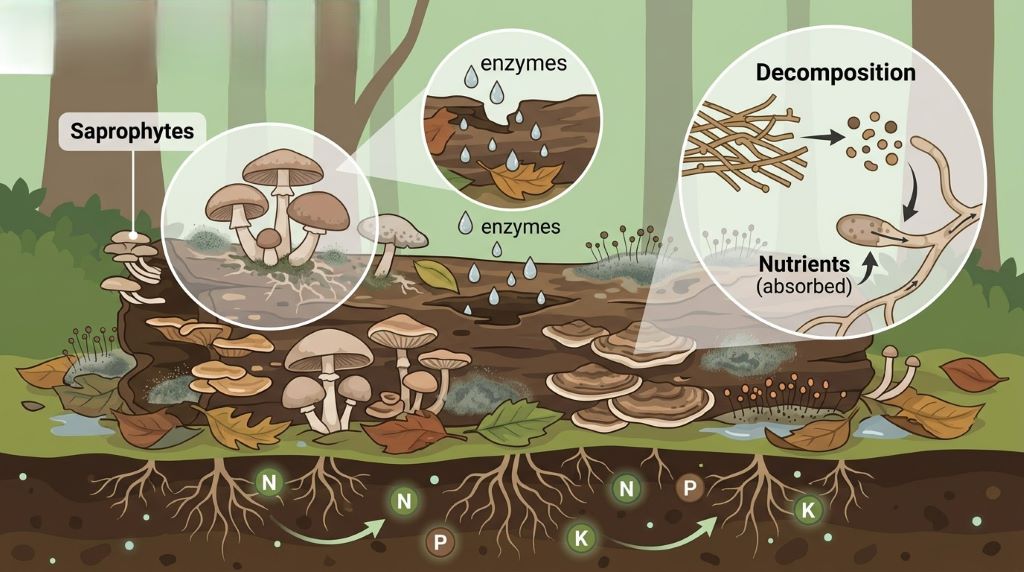
In Modes of Nutrition (Autotrophic & Heterotrophic), saprophytes act as nature’s clean-up team. They release enzymes onto dead plants and animals. These enzymes break complex matter into simple nutrients, which they then absorb.
A common example is mushrooms growing on logs. Many fungi, such as molds like Rhizopus and mushrooms like Agaricus, follow this method. They live on forest floors and decaying wood, where they break down waste.
As a result, saprophytes help keep soil rich and healthy. This role is very important for farming, environmental science, and ecology
Real-Life Applications
Engineering Photosynthesis for Food and Energy
Scientists are trying to improve how autotrophs make food. They are changing photosynthesis so plants can capture more carbon dioxide. This can help reduce climate change and grow more food.
Right now, most plants use only about 1% to 2% of sunlight to make energy. In contrast, solar panels can use about 20% of sunlight to produce electricity. In simple terms, this means natural photosynthesis is much less efficient than modern solar technology.
So, scientists are building new systems. These are called hybrid or semi-artificial photosynthesis systems. They mix biology with modern chemistry. Some of these systems use special materials that capture sunlight better than natural ones.
Heterotrophic Nutrition in Medicine and Agriculture
In Modes of Nutrition (Autotrophic & Heterotrophic), understanding heterotrophic nutrition is very useful in real life. It helps farmers protect crops from harmful fungi and also helps doctors treat infections caused by bacteria and parasites. It also helps scientists study how waste breaks down and how soil stays fertile.
For example, a doctor treating a tapeworm uses knowledge of parasitic nutrition. A farmer controlling fungal disease uses knowledge of saprophytic nutrition. In simple terms, these ideas are not just theory—they are used every day in real jobs.
Artificial Food Production Using Autotrophic Principles

Scientists are building new ways to make food using sunlight and simple chemicals. They use solar panels and special reactions to help plants grow more efficiently. In some cases, this method can be up to 18 times more efficient than normal photosynthesis.
Some plants, like cowpea, tomato, tobacco, rice, canola, and green pea, can even grow using carbon from acetate in the dark. This means food can be produced without sunlight in certain conditions.
It may sound like science fiction, but it is based on the same photosynthesis you learn in class. If you study fields like chemical biology or plant biotechnology, you could work on these ideas in the future.
Conclusion
All living things need energy to survive. They get this energy in two ways. Some organisms make their own food. These are called autotrophs. Other organisms eat plants or animals for food. These are called heterotrophs.
Both types are very important. Autotrophs produce food from sunlight. Heterotrophs consume that food for energy. Together, they keep energy moving through nature. This balance supports all life on Earth. It also plays a big role in science, health, and the environment.
Get more information on STEM-Quiz
Frequently Asked Questions
Autotrophs make their own food from simple materials like water and carbon dioxide. In contrast, heterotrophs cannot make their own food, so they get energy by eating other organisms or organic matter. In simple terms, one group produces food, while the other depends on it for survival.
Humans follow holozoic nutrition. In this process, we take in food and break it down inside the body. For example, organs like the stomach and intestine help digest food. As a result, nutrients are absorbed into the blood, and the body removes the waste that is left.
In parasitic nutrition, the parasite often harms the host. In contrast, some relationships are more balanced and not fully harmful. For example, certain bacteria in the human gut were once seen as parasites. Now, they are known to help with digestion and support the immune system.
Reference
Weithff, G. and Wacker, A (2007), The mode of nutrition of mixotrophic flagellates determines the food quality for their consumers. Functional Ecology, 21: 1092-1098. https://doi.org/10.1111/j.1365-2435.2007.01333.x
- About the Author
- Latest Posts

I hold an M.Sc. from the University of Allahabad, with a specialization in molecular biology, microbiology, and genetics. My academic training has provided me with a strong foundation in life sciences and research-based learning. Alongside my studies, I have gained valuable professional experience in both education and social development.
I worked at A.M. Oxford Public School, where I guided students toward academic success and encouraged curiosity and critical thinking. This role helped me develop effective teaching methods and strong communication skills. In addition, I contributed to the Jeevan Jagriti Foundation, where I actively participated in community programs focused on improving educational access and awareness among underprivileged groups.
Through these experiences, I built important interpersonal, leadership, and organizational skills. Working in diverse environments allowed me to understand both classroom dynamics and real-world social challenges. I remain committed to using my knowledge and skills to support education, promote scientific understanding, and contribute to meaningful community development initiatives.