
Estimated reading time: 11 minutes
Consider the air around you, which remains completely invisible and untouchable to the human senses. Can you see anything? Your answer will be no. However, in the early nineteenth century, John Dalton, a self-taught English instructor from Manchester, courageously attempted to explain what air and all other matter are actually made of. His revolutionary idea, which he later on termed as the “Dalton’s Atomic Theory,“ proposed that everything in the universe consists of microscopic atoms, with each element containing its own type which differs from all other atoms. Although many scientists initially dismissed atoms as nothing more than a mental illusion with no basis of reality, Dalton’s groundbreaking ideas eventually became the solid foundation upon which all of modern chemistry was built upon. Prior to his remarkable work, scientists struggled tremendously to answer even the most basic questions about matter and chemical combinations, such as:
“Why do chemicals often mix together, why can’t you turn lead into gold? What makes elements different from each other“?
As time passed by, Dalton’s atomic theory addressed each of these issues and provided a solid foundation for chemistry. At the same time, he faced serious challenges because he couldn’t also see atoms directly. Hence, he depended on unproven evidence and made more educated guesses about all chemical formulae. Some assumptions were proved incorrect, however, his fundamental concepts held a very significant value. Below, we explore Dalton’s remarkable journey and demonstrate how curiosity outweighs formal qualifications.
Also Read: What Is Chemical Equilibrium and Its Importance?
What Is Dalton Atomic Theory and It’s Importance: Key Takeaways
- John Dalton proposed his atomic theory in 1803, thus fundamentally changing the field of chemistry by introducing measurable atoms.
- His theory asserted that all matter consists of atoms, which can neither be created nor destroyed, and hence can combine in fixed ratios.
- Dalton correctly predicted crucial concepts like atoms being the basic building blocks of matter and the Law of Multiple Proportions.
- Despite facing criticism and making some incorrect assumptions, Dalton’s core ideas laid the groundwork for today’s chemistry.
- Dalton’s legacy lasts forever in science, emphasizing that curiosity and observation can lead to significant discoveries.
Who Was John Dalton?
John Dalton was born in the year 1766 in Eaglesfield, England. He came from a poor Quaker family with very limited resources. Despite his humble beginnings, Dalton led an extraordinary life. His relentless curiosity about nature continually fueled his ambitions for success. Dalton had very little formal education while growing up. However, his passion for learning remained unwavering throughout his lifetime. By the age of 12, Dalton was already teaching other children. In fact, he taught at a small village school near his house. As a result, he learned a lot by teaching others around him. This early start was pivotal in shaping his entire career as a teacher, chemist and a physicist.
In 1793, Dalton relocated to Manchester as a young man. Shortly after, he joined the Literary and Philosophical Society. This institution served as his intellectual home for his lifetime. What’s more remarkable is that he routinely delivered lectures on mathematics and science. He worked as a meteorologist as well. He meticulously documented the weather observations for 57 years in a row which aided him in his discovery. Manchester provided Dalton with all the scientific resources and connections that he needed. Additionally, he encountered other curious individuals who shared the same interests with him. In the due course of time, he rose to prominence as a respected researcher during his time.
Also Read: Human Respiratory System: The Silent Rhythm of Every Breath
From Weather to Atoms
Now that we have understood Dalton’s biography, let’s move on to his findings. He specifically questioned:
” Why the mixture of various gases was so uniform? “
This inquisitiveness prompted him to consider more significant issues regarding the matter itself. It was at this moment when he realized something crucial. Perhaps, gases were made up of minuscule particles that were too small to see. These particles may vary in weight and size as well. This thought process ultimately resulted in his well-known atomic hypothesis which he drafted after his research. However, Dalton saw something strange to support his logic. Even though certain gases readily dissolve in water, others do not. For instance, the behaviour of hydrogen and oxygen will differ significantly. He assumed that factors such as particle size and weight may have played a role and studied about their interaction in further detail. Even though Dalton started his research by studying the clouds and rain, he ended up explaining what everything is made out of and the reasons behind why these reactions occur in science.
What Is Dalton’s Atomic Theory?
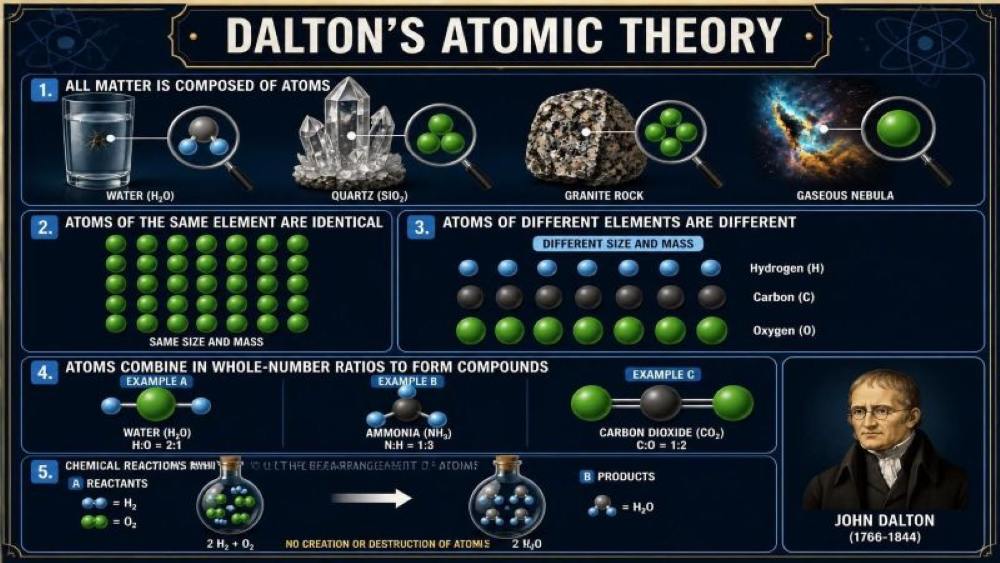
Fig.1: An Infographic on Dalton ‘s Atomic Theory
Dalton’s atomic theory stands out as one of science’s greatest achievements. Ancient Greeks have often spoken about indivisible particles. However, it was not that well known during that period. Dalton managed to change this thought completely with his groundbreaking approach. As a matter of fact, the concept of atoms has existed for centuries even before Dalton. To imagine this, philosophers such as Democritus proposed that tiny particles of matter have existed before. However, these ideas were not that strong as these remained unproved. Dalton managed to refine those ideas well. With this, he transformed philosophy into measurable science.
Dalton circulated his theory to everyone. Above all, he provided strong proof through all of his chemical tests which no one could do. He demonstrated how atoms described itself. Additionally, his ideas foresaw the future findings. Atoms become measurable objects for the first time in history. Through his findings, chemists were able to compare various elements quantitatively.
The Five Main Principles
This theory consisted of five key points that completely transformed chemistry. Here are Dalton’s core principles:
- All matter is made of tiny atoms.
- Atoms cannot be created or destroyed.
- Atoms of same element are all identical.
- Atoms of different elements have different weights.
- Atoms combine in simple, fixed ratios.
Above all, the fifth principle proved to be especially important. In essence, it explained why chemicals combine in predictable amounts. Moreover, this principle enabled scientists to calculate the atomic weight accurately. These five principles in combination, formed a complete framework. To put it differently, Dalton gave chemistry it’s first real rules. Prior to his work, chemical combinations seemed very random and unpredictable. With this theory, scientists could make accurate predictions about chemical reactions, thereby making Dalton’s five ideas the foundation for all chemistry students.
What Dalton Got Right?
Dalton made several correct predictions that proved his theory’s power. To enumerate on this, Dalton correctly stated these important principles:
- Atoms are the fundamental building blocks of matter.
- Chemical reactions rearrange atoms without destroying them.
- Elements have characteristic atomic weights unique to them.
- Compounds always have fixed compositions by weight.
- Multiple compounds can form from the same elements.
In conclusion, these observations were proven correct; however, it required some refinements and adjustments. This work was later done by many scientists.
The Law of Multiple Proportions
Dalton discovered an important pattern in chemical combinations, which is, two elements can form multiple different compounds together. Moreover, the ratios between them are always simple numbers. In the meantime, this discovery became known as the Law of Multiple Proportions. For example, take the case of nitrogen and oxygen combining together. They will form several different compounds in nature. Suppose in the formula of nitric oxide, the ratio is 1:1. By comparison, in another compound, the ratio becomes 1:2. In the third one, the proportion will shift to 2:1 instead.
Above all, these weren’t random numbers. In essence, they were always simple whole numbers like 1, 2, or 3. To point it out, there were no values like 1.5 or 2.7 which were ever formed. As a result, this pattern strongly supported the atomic theory. Hence, he was able to prove that atoms must combine in fixed amounts for a reaction to be balanced as they must have a whole number of moles.
Also Read: Refraction and How It Affects Your Visual Perception
How Did Dalton Find Atomic Weights?
Determining atomic weights was Dalton’s greatest challenge so far. During those days, there were no instruments which existed that could measure them individually. Hence, Dalton needed to find a creative solution. With this in mind, Dalton developed few clever methods to solve this problem. To begin with, he used chemical reactions as a measuring tool. By analysing how elements combined together, he calculated relative atomic weights successfully. In other words, he compared atoms to each other rather than weighing them alone. This approach was considered ingenious for it’s time.
Additionally, Dalton relied on careful observations. He measured how much of each element will be combined with to form compounds. He recorded these measurements with remarkable precision. In the due course of time, specific patterns emerged from his detailed data. In conclusion, Dalton turned an impossible task into a solvable problem. All things considered, his measuring techniques revolutionized chemistry completely.
The Rule of Greatest Simplicity
Dalton faced another significant challenge in his research; he didn’t know the chemical formulas for all compounds. To illustrate,
“How many atoms are there in water? Was it one hydrogen and one oxygen? Or perhaps something else entirely”?
With this in mind, he made a simple assumption. If only one compound exists between two elements, what could the simplest formula possibly be. In essence, one atom plus one atom seemed logical. Hence, this became his famous “rule of greatest simplicity.” Here’s how he applied it in practice:
- Water: one hydrogen + one oxygen = HO
- Ammonia: one nitrogen + one hydrogen = NH
- With only one known compound, he assumed it as a 1:1 ratio.
At any rate, this method posed a lot of obstacles during his research and needed to be further refined as his research progressed.
Why Did Some Scientists Doubt Dalton?
Despite his achievements, Dalton faced serious criticism from his colleagues. To many, his formulas were often guesses without any solid proof. To add, he couldn’t prove atoms existed directly. Moreover, the suggested atomic weights kept changing over time. Hence, his work seemed arbitrary and unscientific to many researchers.
Dalton was very confident with his work throughout his career. In fact, some historians say he was too confident for his own good. For example, Gay-Lussac discovered important gas laws in 1808. These laws actually supported the presence of atoms perfectly. However, Dalton rejected Gay-Lussac’s conclusions with stubbornness. In essence, he refused to accept any evidence which contradicted his views. Dalton’s stubbornness slowed the scientific progress considerably as he was not willing to accept any of ideas proposed by other scientists.
What Did Dalton Get Wrong?
In reality, his rule of simplicity often failed. Dalton often thought oxygen gas consisted a single atom floating freely. However, he didn’t realize elements actually form pairs. In reality, oxygen gas is O₂ molecule with two atoms bonded together. This concept came from the scientist Avogadro in 1811, yet Dalton refuted this idea. Above all, his basic framework remained fundamentally correct. In due time, scientists fixed his mistakes while keeping the core ideas in place.
Also Read: Understanding What Are Irrational Numbers and their examples
Conclusion
In essence, Dalton shows that simple ideas can explain incredibly complex things about the world around us. As discussed earlier about Dalton’s life and his discovery, we understand the hardships faced by this incredible scientist. What’s more is, Dalton’s remarkable journey teaches us the valuable lessons that no books can teach us well. Although there were mistakes in his findings, we are able to study the concepts of moles efficiently.
At present, scientists can actually see individual atoms using powerful microscopes and advanced imaging technology. To put it differently, what Dalton could only imagine during his time, we can now observe it directly with our own eyes. We can also draw the structure of an atom, which wasn’t possible during those days. In conclusion, Dalton’s legacy lives on in every chemistry classroom worldwide. Every time students use his theory to balance chemical equations, calculate molecular weights, or study the periodic table, they use principles that were established by him over 200 years ago. All things considered, the atoms he imagined continue to explain everything around us.
Frequently Asked Questions (FAQs)
Dalton proposed his atomic theory in 1803 while working in Manchester, England.
Dalton earned this title by first connecting atoms to real experiments and giving them measurable properties.
Dalton assumed water was HO instead of H₂O due to his “rule of greatest simplicity.”
Dalton measured relative weights by comparing elements in reactions, using hydrogen as his baseline.
This law states that elements forming multiple compounds always combine in simple ratios like 1:1, 1:2, or 2:1.
Dalton refused to accept Avogadro’s molecular theory as he believed that gases like oxygen form pairs (O₂) instead of single atoms.
Students use Dalton’s principles to balance equations, calculate molecular weights, and understand chemical reactions.
References:
- Chandler, J. (2017). An introduction to the foundations of chemical information Theory. Tarski–Lesniewski Logical structures and the organization of natural sorts and kinds. Information, 8(1), 15. https://doi.org/10.3390/info8010015
- Constable, E. C. (2021). John Dalton – the man and the myth. Dalton Transactions, 51(3), 768–776. https://doi.org/10.1039/d1dt04135e
- Kozlov, M. G. (2021). Some current trends in atomic theory. Symmetry, 13(8), 1486. https://doi.org/10.3390/sym13081486
- Salvi, P. R. (2025). On the Birth of Modern Chemistry: I—The Atomic–Molecular Theory from Dalton to Avogadro. Histories, 5(1), 8. https://doi.org/10.3390/histories5010008
- About the Author
- Latest Posts

Ms. Adrita Roy is a dual master’s holder specializing in Biological Sciences and Sustainable Development. She completed her Master’s in Biological Sciences from Bangalore University in 2025, followed by a Master’s in Sustainable Development from the University of Sussex in 2026.
With over three years of professional experience across biosciences, sustainability, education, ESG consulting, and science communication, Ms. Roy has developed a multidisciplinary profile focused on research, sustainability, and impactful communication.
Her subject expertise includes Biological Sciences, Sustainable Development, ESG consulting and sustainability frameworks, science communication, environmental awareness communication, and sustainability-focused content development. She also possesses expertise in Biology and Chemistry academic content development for Classes 11 and 12, including MCQs, assignments, case studies, and educational learning resources.
Ms. Roy is experienced in scientific writing, journal drafting, research communication, policy drafting, stakeholder engagement, sustainability reporting, web content creation, marketing communication, case study preparation, and master sheet preparation. Her multidisciplinary background enables her to combine research-oriented knowledge with effective communication strategies in the fields of science, sustainability, and education.