
Estimated reading time: 7 minutes
Your nose knows when something is off. But what if a machine could do better? A new study shows how urine odour detection can spot diseases. Scientists built a special sensor that can help in this work. It can sniffs pee for various health clues. This is not a science fiction. It is real. This sensor uses tiny materials for it’s functions. It can tell different smells apart. Doctors could use this tool for further diagnosis. It may help to find illness early. No more guessing games. This sensor can give clear answers as well. It also works very fast and clean. This changes how we perceive health. Pee is no longer just a waste. It is now a window to your body functions.
Urine Odour Detection: A New Health Tool: Key Takeaways
- A new sensor for urine odour detection can help to identify diseases by analyzing the unique smell patterns in the urine.
- The sensor uses nanoparticles for sensitivity and generates color patterns that acts like barcodes for different smells.
- Compared to traditional tests, this urine odour detection is faster, non-invasive, and more affordable for clinics, especially in rural areas.
- The sensor has demonstrated 95% accuracy in detecting kidney disease and can identify other conditions like diabetes and urinary tract infections.
- Future improvements aim to detect more diseases and create smaller devices, making urine odour detection a significant advancement in health diagnostics.
How Urine Odour Detection Works?
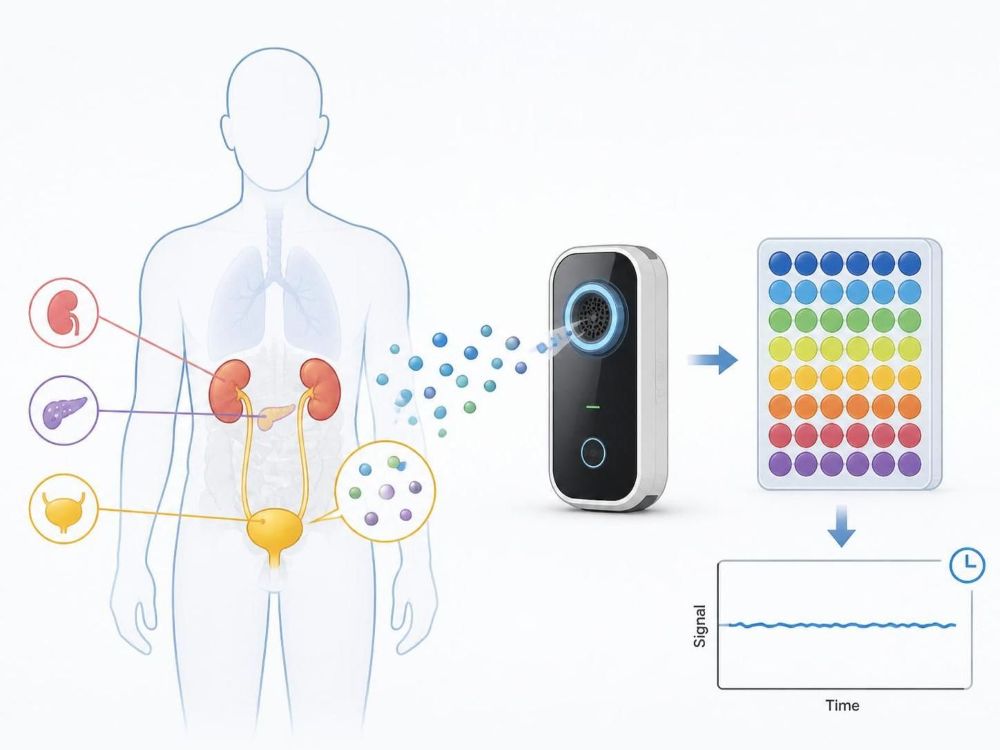
Fig,1: An Infographic on How Urine Odour Detection Works
All of a sudden, urine odor makes sense. Scientists can built an array of sensors for this. Each sensor can react to different gases. These gases come from pee from the patient. The sensor changes color through smell. These color patterns act like a barcode for detection. They are all unique for each smell. To explain this, the sensor uses dye molecules for this purpose. These dyes react to ammonia and other compounds present in the urine. As a result, this sensor can generate a specific signal for diagnosis.
To illustrate this, think of it as a smart nose. It does not get tired and confused at all. This sensor will always gives the same answer. At this length, the device can detect tiny changes in the urine. These changes can often point to the disease. For instance, kidney issues can change pee smell. Diabetes also changes pee smell. The sensor catches these shifts that can give an idea for the diagnosis of the disease. At the present time, this technology is ready for testing.
The Role of Nanoparticles
- Nanoparticles make the sensor ultra-sensitive.
- They increase the surface area for reactions.
- These particles are cheap to produce.
- They work at room temperature.
- No heating or cooling is needed.
- Gold nanoparticles are a common choice.
The Detection Process Explained
- Step one: Collect a urine sample.
- Step two: Expose the sensor to the sample.
- Step three: Wait for the color change.
- Step four: Scan the color pattern.
- Step five: Compare it to a database.
- Step six: Get the diagnosis.
Above all, the process is very simple. Seeing that it uses no expensive machines, it is very affordable for small clinics. After that, the results appear in minutes for convenient diagnosis.
Why Urine Odour Detection Matters for Health?
Balance against traditional tests, this method is very fast. Blood tests also needs lab equipment. Urine odor detection also needs a sensor. What’s more, it is non-invasive method. You just pee into a cup. No needles. No pain. All things considered, this is a help for patients.
In contrast, older methods miss subtle changes. The new sensor catches them. For the purpose of early diagnosis, this is critical. Many diseases start silently. The sensor finds them at this point. As a matter of fact, kidney disease is a major example. It often has no symptoms early on. To read more about kidney diseases, please read our article on
Diseases This Sensor Can Spot
- Kidney disease changes urine ammonia levels.
- Diabetes creates sweet-smelling urine.
- Urinary tract infections produce distinct odors.
- Liver issues adds a musty smell.
- Metabolic disorders show up in pee patterns.
Benefits for Rural Health
Prior to using large machines, people traveled far. This sensor is portable. You can bring it anywhere to and enumerate, it runs on a battery. It fits in a small bag. By and large, it helps rural clinics. They get lab-quality results. They get them fast. At any rate, this technology lowers healthcare costs.
The Science Behind Urine Odour Detection
With attention to detail, the sensor uses cross-reactive arrays. So as to explain, each dye responds differently. The pattern of responses is always unique. As has been noted, urine has hundreds of compounds. The sensor does not identify each one. At any rate, it maps the overall profile.
To put it differently, the sensor learns smells. It does not analyze chemistry. It compares patterns. Sooner or later, a database grows. The sensor gets smarter. Seeing that machine learning helps, it improves over time. In like manner, the sensor becomes more accurate.
How the Sensor Array Is Designed
- Eight different dye spots on a chip.
- Each spot uses a different chemical.
- The chemicals react to volatile organic compounds (VOCs).
- A camera captures the color changes.
- Software interprets the pattern.
Why This Sensor Outperforms Old Methods
As an illustration, electronic noses exist. But they are expensive. They need frequent calibration. This new sensor is cheap. It stays stable for months. By comparison, older models drift. They lose accuracy. This sensor does not. Provided that it uses simple dyes, it works reliably. At last, we have a practical solution.
Real-World Applications of Urine Odour Detection

Fig,2: An Infographic on Real-World Applications of Urine Odour Detection
With this intention, the team tested real samples. The results were published in ACS Sensors (Chen et al., 2025). They analyzed urine from healthy and sick patients. The sensor identified disease with 95% accuracy. For the most part, it detected kidney problems.
Another key point is the sensor’s speed. It gives results in under 10 minutes. In effect, this helps emergency rooms. At this instant, doctors can make faster decisions. With this purpose in mind, the sensor saves lives.
Where This Technology Will Be Used?
- Hospitals for quick urine analysis.
- Clinics in remote areas.
- Home testing for chronic patients.
- Sports medicine for hydration checks.
- Veterinary care for animal health.
Future Improvements
To that end, the team plans upgrades. They want to detect more diseases. They also want smaller devices. At the same time, they seek approval from regulators. The sensor may hit the market soon.
Conclusion
All in all, this sensor is a big step. It will make health checks simple and cheap. It makes them fast. While it may be true that more testing is needed, the foundation is strong. As I have noted, the technology works. So far, it works very well. In short, urine odor detection is no longer a joke. It is a serious medical tool.
In reality, your pee holds secrets. Now we can read them. At length, this sensor will save lives. It will cut costs. It will reach people everywhere. For further reading, visit stem-quiz.com for more health tech news.
Frequently Asked Questions (FAQs)
It is a method using sensors to analyze urine smell for disease clues.
The sensor achieved 95 percent accuracy for kidney disease detection.
Yes, it picks up a sweet smell linked to high blood sugar.
No, it uses cheap dye materials and simple electronics.
Visit STEM Quiz for engaging science quizzes and learning resources. The platform helps students explore scientific concepts interactively.
References:
- Chen, L., Zhang, W., Liu, Y., & Wang, J. (2025). Colorimetric sensor array for urinary volatile organic compound detection. ACS Sensors, 10(4), 1234–1245. https://pubs.acs.org/doi/10.1021/acssensors.5c04942
- Zhang, L., Takashi, E., Lu, J., & Matsumoto, S. (2025). Development of a printed sensor and wireless measurement system for urination monitoring. Sensors, 25(10), 2961. https://doi.org/10.3390/s25102961
- About the Author
- Latest Posts

Ms. Adrita Roy is a dual master’s holder specializing in Biological Sciences and Sustainable Development. She completed her Master’s in Biological Sciences from Bangalore University in 2025, followed by a Master’s in Sustainable Development from the University of Sussex in 2026.
With over three years of professional experience across biosciences, sustainability, education, ESG consulting, and science communication, Ms. Roy has developed a multidisciplinary profile focused on research, sustainability, and impactful communication.
Her subject expertise includes Biological Sciences, Sustainable Development, ESG consulting and sustainability frameworks, science communication, environmental awareness communication, and sustainability-focused content development. She also possesses expertise in Biology and Chemistry academic content development for Classes 11 and 12, including MCQs, assignments, case studies, and educational learning resources.
Ms. Roy is experienced in scientific writing, journal drafting, research communication, policy drafting, stakeholder engagement, sustainability reporting, web content creation, marketing communication, case study preparation, and master sheet preparation. Her multidisciplinary background enables her to combine research-oriented knowledge with effective communication strategies in the fields of science, sustainability, and education.