Estimated reading time: 8 minutes
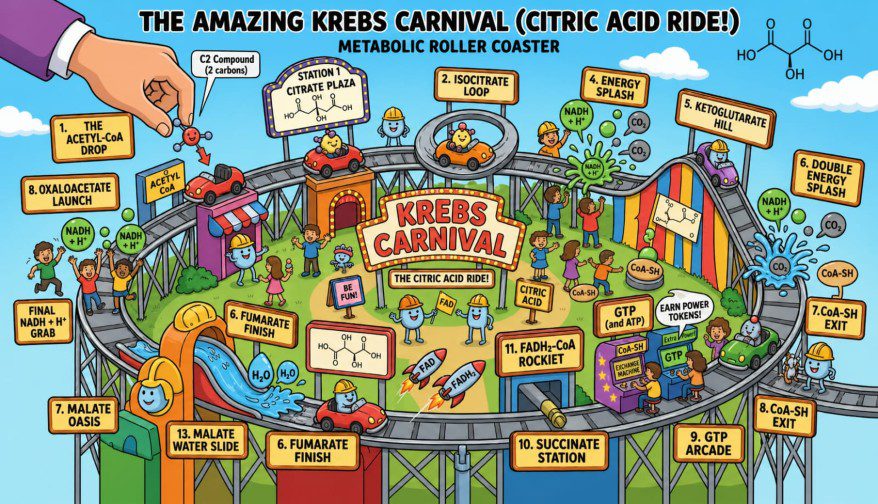
Every time you eat a meal, your body gets to work. It breaks your food down into smaller and smaller pieces. At last, it reaches the smallest unit of all — glucose. Your cells then use glucose to make energy. But how exactly does that happen? That is where the Krebs Cycle comes in. The Krebs Cycle is one of the most important stages of aerobic respiration. It happens deep inside your cells, in a tiny structure called the mitochondria. In essence, it is a series of chemical reactions that help release energy from food. As a result, it keeps every living cell running..
What Is the Krebs Cycle?
The Krebs Cycle is also knows as the Citric Acid Cycle. It honors the British scientist Sir Hans Krebs, who discovered it in 1937. What’s more, this discovery was so important that he won the Nobel Prize in Physiology or Medicine in 1953. In short, the circular set of chemical reactions takes place in the matrix of the mitochondria — the fluid-filled inner space. Before the Krebs Cycle begins, glucose is already partially broken down. It enters the cycle as a molecule called Acetyl-CoA.
“The Krebs Cycle is nature’s most elegant recycling system — it spins around again and again, pulling energy out of food one step at a time.”
The cycle is called “circular” for a good reason. After each full turn, the starting molecule is regenerated. So the cycle can spin again and again, as long as Acetyl-CoA keeps entering.
Where Does the Krebs Cycle Fit in Respiration?
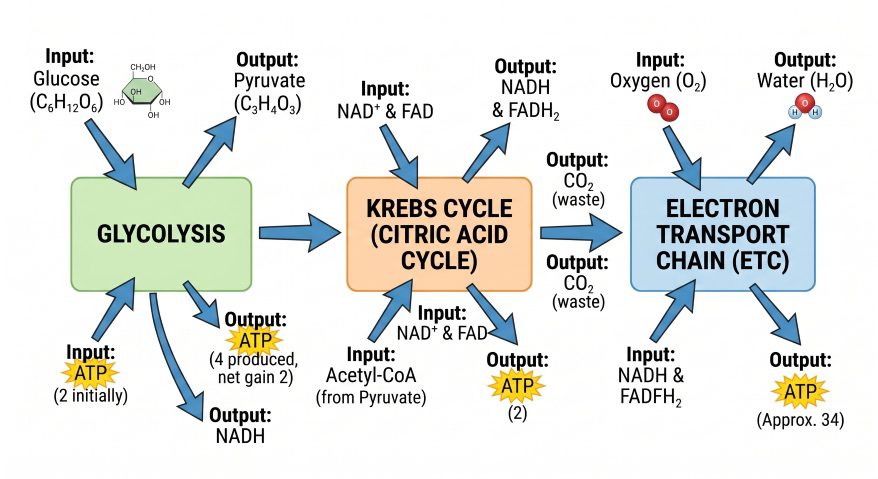
At this point, it helps to see the big picture. Aerobic respiration has three main stages. To enumerate them clearly:
- Glycolysis — happens in the cytoplasm; glucose splits into pyruvate
- Krebs Cycle — happens in the mitochondrial matrix; energy carriers are produced
- Electron Transport Chain — happens on the inner mitochondrial membrane; most ATP is made
As can be seen, the Krebs Cycle sits in the middle. It connects glycolysis to the final stage. After that, the energy carriers it produces are used in the electron transport chain to make most of the ATP.

What Happens Before the Krebs Cycle?
Prior to the Krebs Cycle, a short preparation step called the Link Reaction (also called Pyruvate Oxidation) occurs. After glycolysis, produces two pyruvate molecules, each pyruvate moves into the mitochondria. In this stage, enzymes convert each pyruvate into Acetyl-CoA. Simultaneously, the reaction produces one molecule of NADH. To put it simply — the link reaction prepares the fuel (Acetyl-CoA) so it can enter the Krebs Cycle.
How Does the Krebs Cycle Work? Step by Step
Now, seeing that Acetyl-CoA is ready, the Krebs Cycle can begin. Each turn of the cycle goes through 8 steps. The molecules goes in and comes out.
What Goes Into the Krebs Cycle?
- Acetyl-CoA (2 carbon molecule) — the main fuel that enters the cycle
- Oxaloacetate (4 carbon molecule) — the starting and ending molecule of the cycle
- Water (H₂O) — used at several steps
What Comes Out of the Krebs Cycle?
Each full turn of the cycle produces:
- 2 molecules of CO₂ — released as waste; you breathe this out
- 3 molecules of NADH — important energy carriers
- 1 molecule of FADH₂ — another energy carrier
- 1 molecule of ATP (or GTP) — direct energy output
Since glucose produces 2 Acetyl-CoA molecules, the cycle turns twice per glucose. In total, per glucose molecule, the Krebs Cycle produces:
- 4 CO₂ molecules
- 6 NADH molecules
- 2 FADH₂ molecules
- 2 ATP molecules
As a result, while the cycle itself makes only 2 ATP, it produces a large number of energy carriers (NADH and FADH₂). These carriers then go on to power the electron transport chain, where most of the ATP is finally made.
What Are NADH and FADH₂?
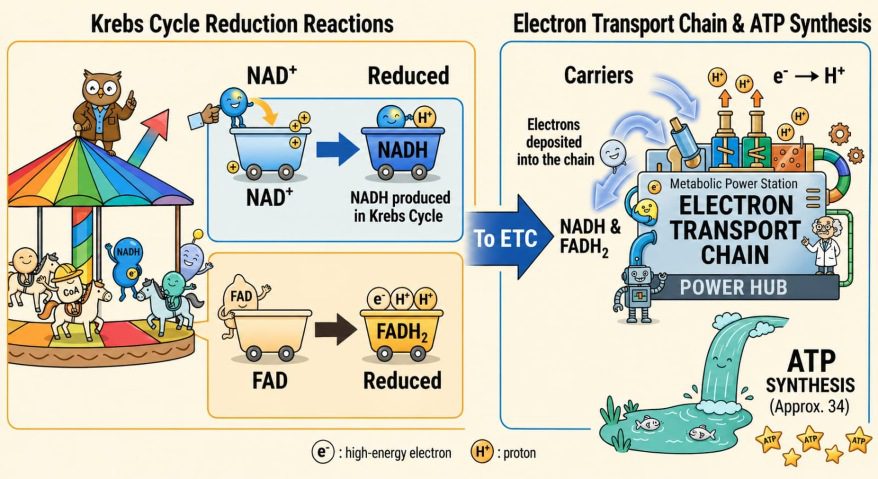
At first, NADH and FADH₂ might seem like strange terms. To put it another way, think of them as rechargeable energy shuttles. NAD⁺ and FAD are molecules that pick up electrons and hydrogen during the Krebs Cycle. When they do, they become NADH and FADH₂ — their charged, energy-rich forms. After that, they carry this energy to the electron transport chain. There, they release the energy to make ATP. In light of this, the Krebs Cycle is not just about making ATP directly. It is about preparing the energy carriers that will power the next stage. In short, it is the supplier, and the electron transport chain is the main factory.
Table 1: A Quick Summary Table
| What | Details |
|---|---|
| Also called | Citric Acid Cycle |
| Discovered by | Sir Hans Krebs (1937) |
| Location | Matrix of the mitochondria |
| Fuel that enters | Acetyl-CoA |
| Turns per glucose | 2 times |
| CO₂ produced | 4 molecules (2 per turn) |
| NADH produced | 6 molecules (3 per turn) |
| FADH₂ produced | 2 molecules (1 per turn) |
| ATP produced | 2 molecules (1 per turn) |
Why Is It So Important?
All things considered, the Krebs Cycle might seem like it produces very little ATP on its own. However, its real value lies in producing NADH and FADH₂. These molecules carry the energy forward into the electron transport chain, which then makes about 34 ATP molecules. With this in mind, it is like the middle manager in a factory. It does not do all the work, but without it, the whole system breaks down. As noted, the cycle also plays a role beyond just energy production. Many of the molecules produced during the Krebs Cycle is used as building blocks for other important substances in the body — such as amino acids and fats.
As a result, it connects energy production to many other processes in the cell. What’s more, it only works in the presence of oxygen. It is a key part of aerobic respiration. If oxygen is not available, the cycle stops. In that case, the cell switches to anaerobic respiration instead.
Real-Life Connection: Why Should You Care?
To illustrate why the Krebs Cycle matters in real life — every time you run, think, breathe, or grow, your cells are using the energy produced through this cycle. Many diseases are linked to problems in the Krebs Cycle. For example, certain types of cancer involve mutations that affect Krebs Cycle enzymes. In similar fashion, some genetic conditions can disrupt the cycle and cause serious health problems.
Summary: The Krebs Cycle
To sum up, here is everything you need to know:
- The Citric Acid Cycle is the second stage of aerobic respiration.
- It takes place in the matrix of the mitochondria.
- It was discovered by Sir Hans Krebs in 1937.
- Glucose enters the cycle as Acetyl-CoA (after the link reaction).
- Each turn produces 2 CO₂, 3 NADH, 1 FADH₂, and 1 ATP.
- The cycle turns twice per glucose molecule.
- Its biggest contribution is producing NADH and FADH₂ — energy carriers for the next stage.
- Without it, the electron transport chain cannot make most of the cell’s ATP.
In conclusion, the Krebs Cycle is at the heart of how your cells make energy. It may look complicated at first, but all things considered, it is just a smart recycling system that keeps your cells powered up.
Frequently Asked Questions (FAQs)
The Krebs Cycle is a circular series of chemical reactions inside the mitochondria. It breaks down Acetyl-CoA to release energy. It releases CO2 as waste and generates energy carriers (NADH and FADH₂) for the cell to use in the next stage of ATP production.
Scientists call it the Citric Acid Cycle because the reaction between Acetyl-CoA and oxaloacetate forms citric acid (citrate) as the very first molecule. The name “Krebs Cycle” honours the scientist who discovered it — Sir Hans Krebs.
The Cycle turns twice per glucose molecule. This is because one glucose molecule produces two Acetyl-CoA molecules during earlier stages of respiration.
While the cycle does make 2 ATP directly, its most important products are NADH and FADH₂ — energy carrier molecules. The electron transport chain uses these carriers to produce most of the cell’s ATP.
The Cycle takes place in the matrix of the mitochondria — the fluid-filled central space inside the mitochondria.
Not directly. Oxygen is not used during the Krebs Cycle itself. However, the cycle only works as part of aerobic respiration. Without oxygen available for the next stage (electron transport chain), it eventually stops.
Reference
- Arnold P, Finley L Regulation and function of the mammalian tricarboxylic acid cycle Journal of Biological Chemistry, 2022; 299 https://doi.org/10.1016/j.jbc.2022.102838
- About the Author
- Latest Posts

Ayushi Shukla is a biotechnologist and science communicator specializing in the intersection of genomic data and public health. Previously, she served as a Core Member and R&D Lead at the HealthTech venture Eat Wisely Bro, where she spearheaded research initiatives and translated emerging medical data into product strategy. She holds an M.Sc. in Biotechnology from the TERI School of Advanced Studies, where her research at The Energy and Resources Institute (TERI), New Delhi, focused on Environmental Biotechnology and Bioremediation.
As a Research Scholar at TERI, Ayushi developed a plant growth-promoting bacterial consortium for high-salinity agricultural conditions, managing daily laboratory procedures and molecular workflows. Her technical portfolio on GitHub demonstrates her dry lab expertise, featuring end-to-end bioinfomatics pipelines for RNA-Seq analysis, Phylogenetic modeling, and a functional prototype for Mycobacterium tuberculosis Genomic Surveillance & Dashboard.
Her clinical foundation includes advanced training in Somatic NGS and Precision Oncology from the Cancer Research Centre at Tata Memorial Centre, and a professional certification in Good Clinical Practice (GLP) from the NIDA Clinical Trials Network. Ayushi bridges the gap between raw genomic data and student-friendly narratives to help the next generation of scientists understand the transformative power of modern biology.