Estimated reading time: 10 minutes
Your body makes waste every second. Cells break down proteins. They use energy. They release toxins into the blood. As a result, your blood gets dirty very quickly. Now, what cleans it? Your kidneys do this job. They work quietly. They work constantly. In fact, the kidneys filter your entire blood supply about 40 times every single day. Understanding the structure and function of kidneys is one of the most exciting parts of biology. At first, the kidney may look like a simple bean-shaped organ. But in reality, it is an incredibly complex and intelligent machine.
Key Takeaways:
- Kidneys filter 180 liters of blood daily
- The nephron is the functional unit
- The loop of Henle conserves water
- Kidneys regulate blood pressure
- Blood pH is held at 7.4 .
- Simple habits protect kidney health
- Kidney damage is often silent
What Are the Kidneys? A Quick Overview
To begin with, the kidneys are a pair of organs in the human excretory system. They belong to the urinary system. Together with the ureters, urinary bladder, and urethra, they form the body’s main waste-removal pathway.
“The kidneys are remarkable organs. They filter approximately 180 liters of fluid daily, yet produce only 1 to 2 liters of urine.”
In general, the kidneys perform three core jobs:
- They filter metabolic waste from the blood.
- They regulate water and salt levels in the body.
- They maintain the pH balance of the blood.
To put it simply, the kidneys are the body’s master filtration plant. They never take a day off.
Where Are the Kidneys Located?
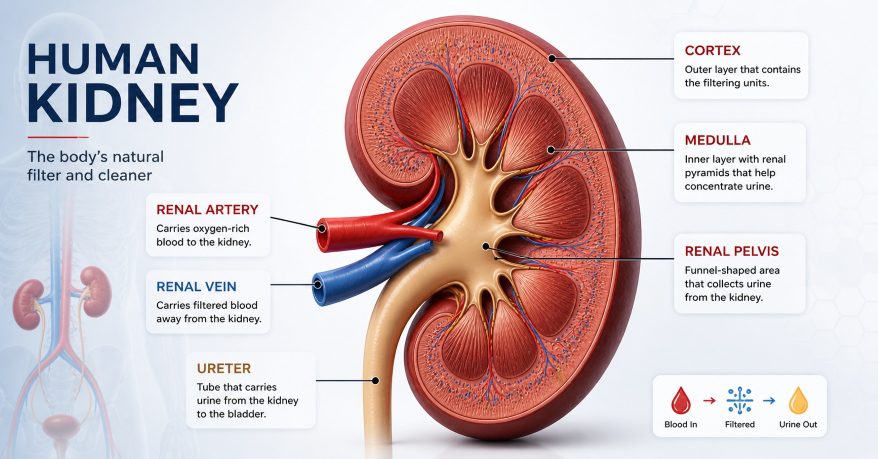
The kidneys sit inside the abdominal cavity. They are located on either side of the vertebral column. As a matter of fact, they rest just below the diaphragm and behind the peritoneum. The right kidney sits slightly lower than the left. This is because the liver takes up space on the right side. More specifically, each kidney is about 10 to 12 cm long. It is about 5 to 6 cm wide. It weighs roughly 150 grams — about the same as a large bar of soap. Overall, their position protects them from physical damage. A slight depression on the inner curved side of the kidney is called the hilum. The renal artery, renal vein, and ureter all connect to the kidney through the hilum.
External Structure of Kidneys: What They Look Like
At first glance, the kidney has a distinctive bean shape. The outer surface is smooth and convex. The inner surface is concave — that is where the hilum sits. Therefore, these protective layers surround each kidney:
- Renal capsule — the innermost layer; a thin, tough, fibrous membrane
- Adipose capsule (perirenal fat) — a layer of fatty tissue that cushions and protects the kidney
- Renal fascia — the outermost layer; a dense connective tissue that anchors the kidney to surrounding structures
Together with these protective layers, the kidney stays safe and firmly in place. Above all, these layers absorb physical shocks so the kidney is not easily damaged.

Internal Structure of Kidneys: What Is Inside
The internal structure of kidneys is where the real action happens. When you cut a kidney in half, you see three distinct regions.
1. Renal Cortex
The renal cortex is the outermost internal region. It appears grainy and dark red. It contains the glomeruli and the proximal and distal convoluted tubules of the nephrons. In short, most of the filtration work begins here.
2. Renal Medulla
The renal medulla is the inner region. It is lighter in color. Furthermore, it contains cone-shaped structures called renal pyramids. These pyramids are separated by extensions of the cortex called renal columns. The tips of the pyramids are called renal papillae. Overall, each papilla drains processed fluid into a small cup called a minor calyx.
3. Renal Pelvis
The renal pelvis is the funnel-shaped chamber at the center of the kidney. It collects urine from all the calyces. After that, it funnels the urine into the ureter, which carries it to the bladder. To enumerate, the flow of urine inside the kidney goes:
Renal pyramid → Renal papilla → Minor calyx → Major calyx → Renal pelvis → Ureter
The Nephron: The Functional Unit of the Kidney
The nephron is the most important part of the kidney’s internal structure. To put it differently, a nephron is the smallest unit that actually performs filtration. In particular, each kidney contains about one million nephrons. Each nephron is a microscopic tube with several distinct parts. Therefore, all nephrons carry out the structure and function of kidneys at the microscopic level.
Parts of the Nephron
Bowman’s Capsule and Glomerulus
At first, blood enters the nephron through a tiny knot of capillaries called the glomerulus. The glomerulus sits inside a cup-like structure called the Bowman’s capsule. Blood pressure in the glomerulus is very high. As a result, small molecules are pushed out of the blood into the Bowman’s capsule. This filtered fluid is called glomerular filtrate. As a matter of fact, large molecules like proteins and blood cells remain in the blood. This stage is called ultrafiltration or glomerular filtration.
Proximal Convoluted Tubule (PCT)
After that, the filtrate moves into the proximal convoluted tubule. This is a highly coiled tube located in the renal cortex. The walls of the PCT are lined with microvilli, which increase the surface area for absorption. In the PCT, glucose, amino acids, water, and useful salts are reabsorbed back into the blood. This is called selective reabsorption. The PCT reabsorbs about 65% of filtered water and almost all filtered glucose.
Loop of Henle
The filtrate then moves into the loop of Henle. This is a U-shaped structure that dips into the renal medulla and comes back up. The loop of Henle has two limbs:
- The descending limb — permeable to water but not salt
- The ascending limb — permeable to salt but not water
This clever design creates a concentration gradient in the medulla. It allows the kidney to produce concentrated urine so that the body conserves water.
Distal Convoluted Tubule (DCT)
After the loop of Henle, filtrate enters the distal convoluted tubule. The DCT fine-tunes the composition of the filtrate. It reabsorbs more water and sodium based on the body’s needs. It also secretes waste like hydrogen ions and potassium ions into the filtrate.
Collecting Duct
At last, the processed filtrate — now called urine — flows into the collecting duct. The collecting duct carries urine from several nephrons toward the renal pyramid. From there, urine drains into the renal pelvis.
Functions of Kidneys: What They Actually Do
Now that you understand the structure, let us look at the functions. The structure and function of kidneys are tightly linked. Each structural part serves a specific function.
1. Filtration of Blood
First of all, the kidneys filter about 180 liters of blood plasma every day. The glomerulus and Bowman’s capsule carry out this filtration. They remove waste like urea, creatinine, uric acid, and excess salts.
2. Reabsorption of Useful Substances
The kidneys do not throw everything out. In fact, they carefully return useful substances to the blood. Then the PCT and DCT reabsorb glucose, amino acids, water, and needed salts. This is one of the most energy-intensive jobs in the body.
3. Secretion of Wastes
In addition, some toxins cannot be filtered out by the glomerulus. As a result, the tubules actively secrete them into the filtrate. These include hydrogen ions, potassium ions, ammonia, and some drugs. This secretion keeps the blood clean and pH-balanced.
4. Regulation of Water and Electrolytes
Furthermore, the kidneys control how much water and salt stay in the body. The hormone ADH (antidiuretic hormone) signals the kidneys to conserve water. The hormone aldosterone signals them to retain sodium. In essence, the kidneys act like a smart thermostat for body fluids. They constantly adjust based on what the body needs.
5. Regulation of Blood Pressure
The kidneys also control blood pressure. When blood pressure drops, the kidneys release an enzyme called renin. Moreover, the renin triggers a chain of reactions that raise blood pressure. This system is called the renin-angiotensin-aldosterone system (RAAS).
6. Production of Hormones
In addition to filtering, the kidneys produce important hormones:
- Erythropoietin (EPO) — stimulates the bone marrow to produce red blood cells
- Calcitriol — the active form of vitamin D; helps absorb calcium from food
To point out, these hormonal functions show that the kidneys do far more than just make urine.
7. Maintenance of pH Balance
Finally, the kidneys maintains the blood’s pH at about 7.4. They do this by excreting hydrogen ions and reabsorbing bicarbonate ions. If blood becomes too acidic or too alkaline, the kidneys quickly correct it.
Blood Supply to the Kidneys
For the kidneys to filter blood, they need a rich blood supply. For this reason ,the renal artery branches directly from the aorta and it brings unfiltered blood into the kidney. Inside the kidney, the renal artery divides into smaller and smaller vessels. Eventually, it forms the afferent arterioles that supply the glomerulus. After filtration, blood exits through the efferent arteriole. Filtered, clean blood drains into the renal vein. The renal vein returns blood to the inferior vena cava and then to the heart.
Common Kidney Disorders You Should Know
Seeing that the kidneys are so vital, damage to them is very serious. To summarize, here are the most common kidney disorders:
Table 1: Common Kidney Disorders.
| Disorder | Cause | Key Symptom |
|---|---|---|
| Kidney Stones | Mineral crystallization in the kidney | Severe back or abdominal pain |
| Urinary Tract Infection (UTI) | Bacterial infection of the urinary tract | Burning during urination |
| Chronic Kidney Disease (CKD) | Long-term kidney damage (diabetes, hypertension) | Fatigue, swelling, reduced urine output |
| Glomerulonephritis | Inflammation of the glomeruli | Blood in urine, high blood pressure |
| Renal Failure | Kidneys stop functioning | Need for dialysis or transplant |
In general, staying hydrated and managing blood pressure greatly reduces the risk of these conditions.
Tips to Protect the Structure and Function of Kidneys
All things considered, a few daily habits make a big difference:
- Drink 8–10 glasses of water daily — keeps the kidneys flushed and reduces stone formation.
- Limit salt intake — excess salt raises blood pressure and damages kidneys over time.
- Avoid overuse of painkillers — NSAIDs like ibuprofen can harm kidney tissue.
- Control blood sugar — diabetes is the leading cause of chronic kidney disease.
- Exercise regularly — improves circulation and supports healthy blood pressure.
- Get regular checkups — sooner or later, early detection saves lives.
Summary: The Kidneys Are Extraordinary
In conclusion, the structure and function of kidneys work hand in hand. Every structural feature — from the nephron to the loop of Henle — serves a precise function.
To sum up, the kidneys:
- Filter 180 liters of blood plasma daily
- Reabsorb glucose, water, and useful salts
- Regulate blood pressure, pH, and fluid balance
- Produce essential hormones like EPO and calcitriol
To put it another way, no other organ in the body does as much with as little. Two small, bean-shaped organs keep your entire body chemistry balanced, 24 hours a day, 7 days a week. With this in mind, treat your kidneys well. Afterall, they are working hard for you every moment of every day.
Frequently Asked Questions (FAQs)
The nephron is the basic structural and functional unit of the kidney. As a matter of fact, each kidney contains about one million nephrons.
Overall, the three internal regions are the renal cortex (outermost), the renal medulla (middle), and the renal pelvis (innermost, funnel-shaped).
The glomerulus is a tiny knot of capillaries inside the Bowman’s capsule. It filters blood under high pressure during the first stage of urine formation.
The loop of Henle creates a concentration gradient in the medulla. As a result, this helps the kidney conserve water and produce concentrated urine.
The kidneys filter approximately 180 liters of blood plasma per day. Furthermore, they produce only 1–2 liters of urine from this filtrate.
The kidneys produce erythropoietin (EPO), which stimulates red blood cell production, and calcitriol, the active form of vitamin D.
Renal failure occurs when the kidneys can no longer filter waste from the blood effectively. As a result, patients may need dialysis or a kidney transplant.
Yes, a high-salt, high-protein diet stresses the kidneys. Dehydration also impairs function. As a matter of fact, a balanced diet and good hydration support healthy kidney structure and function.
Reference
National Institute of Diabetes and Digestive and Kidney Diseases. (2023). Your kidneys & how they work. U.S. Department of Health and Human Services. https://www.niddk.nih.gov/health-information/kidney-disease/kidneys-how-they-work
- About the Author
- Latest Posts

Ayushi Shukla is a biotechnologist and science communicator specializing in the intersection of genomic data and public health. Previously, she served as a Core Member and R&D Lead at the HealthTech venture Eat Wisely Bro, where she spearheaded research initiatives and translated emerging medical data into product strategy. She holds an M.Sc. in Biotechnology from the TERI School of Advanced Studies, where her research at The Energy and Resources Institute (TERI), New Delhi, focused on Environmental Biotechnology and Bioremediation.
As a Research Scholar at TERI, Ayushi developed a plant growth-promoting bacterial consortium for high-salinity agricultural conditions, managing daily laboratory procedures and molecular workflows. Her technical portfolio on GitHub demonstrates her dry lab expertise, featuring end-to-end bioinfomatics pipelines for RNA-Seq analysis, Phylogenetic modeling, and a functional prototype for Mycobacterium tuberculosis Genomic Surveillance & Dashboard.
Her clinical foundation includes advanced training in Somatic NGS and Precision Oncology from the Cancer Research Centre at Tata Memorial Centre, and a professional certification in Good Clinical Practice (GLP) from the NIDA Clinical Trials Network. Ayushi bridges the gap between raw genomic data and student-friendly narratives to help the next generation of scientists understand the transformative power of modern biology.