
Estimated reading time: 6 minutes
Noticed how a mirror shows your exact image? Every morning, you see yourself perfectly reflected back. This happens because light follows specific rules. These rules are called the laws of reflection in physics. Light bounces off surfaces in predictable ways. In fact, scientists discovered these patterns centuries ago. As a result, today, we use these laws in smartphones, telescopes, and cars. Understanding reflection helps explain everyday phenomena. It also powers modern technology you use daily.
Key Takeaways
- Light reflection in physics follows two fundamental laws consistently.
- The angle of incoming light equals the outgoing angle.
- Reversibility principle is a consequence of laws of reflection
- Laws of reflection applies to all smooth surfaces.
- Real-world applications include periscopes, solar panels, and cameras
What are Laws of Reflection in Physics ?
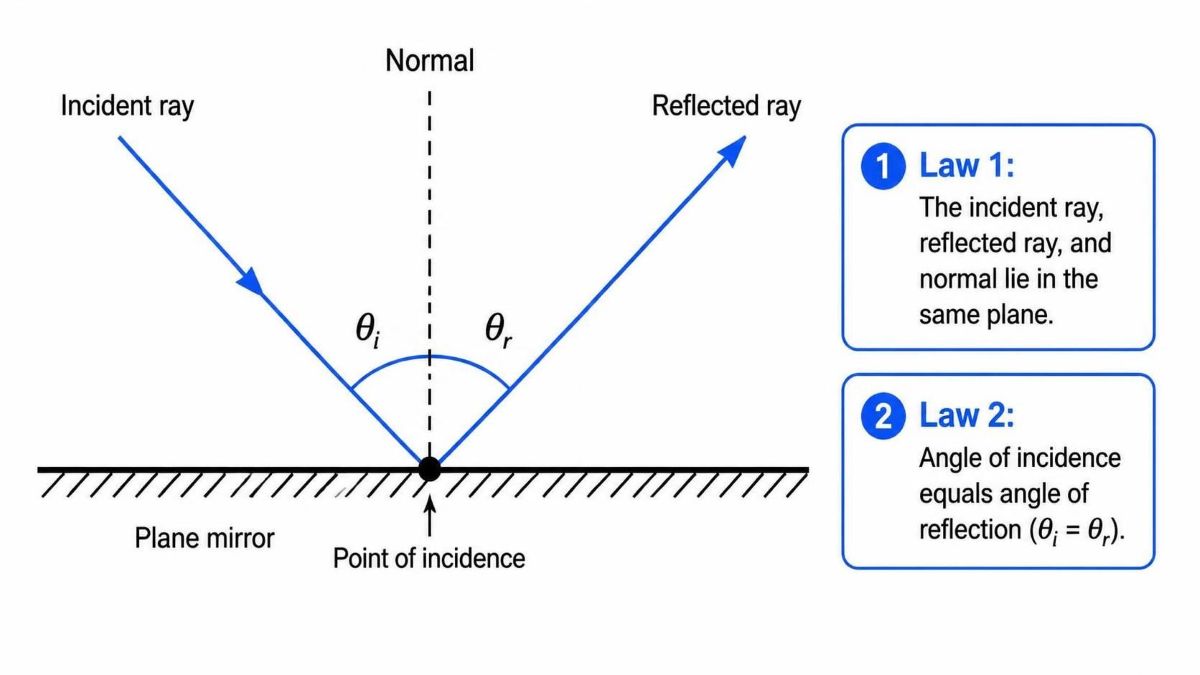
A set of elegant principles, widely known as the Laws of Reflection, shapes how light behaves. Simply put, these laws govern how light bounces off surfaces. Once you understand them, the world of optics begins to make perfect sense. Actually, there are two main laws of reflection of light traditionally recognized in physics. However, some sources include a third principle. The laws of reflection are listed as:
- The first law of reflection
- The second law of reflection
- Law of Reversibility
The First Law of Reflection
“The angle of incidence equals the angle of reflection. “
The angle of incidence equals the angle of reflection. Also can be called law of equal angles. Importantly, this fundamental principle governs all light behavior. To check this, measure the incoming angle with a protractor. You will find that the outgoing angle will match it exactly. For instance, shine light at 30 degrees. The light reflects back at 30 degrees. In fact, this happens every single time without fail.
The Second Law of Reflection
“The incident ray, reflected ray, and normal all exist in the same plane”
The incident ray, reflected ray, and normal lie together. They all exist in the same plane. Also said to be law of coplanarity. Simply put, think of this plane as a flat sheet. All three components stay within this invisible sheet. To illustrate this concept further, imagine a piece of paper. Place it perpendicular to the mirror’s surface. You will notice that the incoming and outgoing rays both touch this paper.
Law of reversibility
“If you reverse the incident ray’s direction, it becomes the reflected ray and vice versa”
Light can travel both directions along any path. Interestingly, if you reverse the incident ray’s direction, something happens. As a result, it becomes the reflected ray and vice versa. This property helps us understand optical systems better. It is more of a general principle of optics.
Note: Most physics textbooks emphasize the first two laws as fundamental. The reversibility principle is a consequence of these laws rather than an independent law. The web search results and standard physics education focus primarily on these two core laws of reflection.
Real-Life Applications of Reflection Laws
Laws of reflection in physics powers numerous devices you use constantly. At the same time, it helps in security systems. Cameras use mirrors to capture multiple angles simultaneously. Above all, these applications make modern life possible:
- Rearview mirrors: Help drivers see behind their vehicles safely
- Telescopes: Gather light from distant stars and galaxies
- Solar panels: Concentrate sunlight for maximum energy collection
- Periscopes: Allow submarines to see above water surfaces
- Dental mirrors: Enable dentists to examine hard-to-reach areas
Scientific Instruments
Scientists rely on reflection principles for advanced research. For example, microscopes use mirrors to illuminate tiny specimens. Laser systems depend on precise reflection angles. In addition, spectroscopes analyze light by reflecting it through prisms. To point out another application, fiber optic cables work. They use total internal reflection forming angle to transmit data. Light bounces inside the cable without escaping.
Entertainment and Art
Kaleidoscopes create beautiful patterns using multiple mirrors. Stage lighting uses reflectors to direct beams precisely. In the same way, photographers manipulate light with reflective surfaces. Ultimately, all these applications follow the same basic laws.
Experiment at Home: Testing Equal Angles
Things become interesting when we see them come live. So test the first law of reflection using this experiment. Place the mirror vertically on white paper. Next, draw a line perpendicular to the mirror. This line, therefore, represents the normal at the surface. Shine the laser at different angles toward the mirror. Measure both the incident and reflected angles. They match perfectly every time. Ultimately, this proves the first law of reflection works.
Materials You Need
The first law of reflection can be tested easily at home. Materials You Need to conduct the above experiment. First, gather these common household items for experiments:
- A flat mirror or any reflective surface.
- Laser pointer or bright flashlight beam.
- Protractor for measuring angles accurately.
- White paper or cardboard as background.
- Ruler for drawing straight lines.
Understand Laws of Reflection: Through Tennis Ball Wall
The laws of reflection in physics describe how light predictably bounces off surfaces. Think of these as the “traffic rules” for light particles traveling through space. To understand this better, imagine you’re playing tennis against a practice wall. First, you throw the ball at the wall at an angle. As a result, the ball bounces back at the exact same angle on the opposite side.
If you throw at 30 degrees from straight-on, it bounces back at 30 degrees. In this analogy, the wall represents the mirror. Meanwhile, your throwing arm is the incident ray. Consequently, the bouncing ball is the reflected ray. The imaginary line straight out from the wall is the normal. This happens whether you’re playing tennis, bouncing a basketball, or skipping stones. Light follows the same predictable pattern.
Conclusion
To sum up, this knowledge empowers you beyond the classroom walls. It helps you appreciate the science behind everyday phenomena you witness. The next time you check your reflection, remember this lesson. Think about those equal angles bouncing light back precisely. Above all, reflection laws prove that physics isn’t abstract theory. It’s real, observable, and incredibly useful in daily life. Consequently, these principles power telescopes exploring distant galaxies and security systems protecting stores. They enable solar panels generating clean energy as well as cameras capturing precious memories. You’re not just looking at mirrors anymore – rather you’re observing precise physical laws in action.
Frequently Asked Questions
When light hits a smooth surface, it bounces predictably. The surface atoms absorb and re-emit photons symmetrically. As a result, this creates the equal angle pattern we observe. Scientists have tested this law thousands of times. Indeed, it works consistently across all smooth surfaces.
There are chiefly two laws of reflection in physics. The law of reversibility is at times considered as third law of reflection in physics.
The first law of reflection in physics states that the angle of incidence is equal to the angle of reflection. It is certainly the law of equal angles.
The second law of reflection in physics states that the incident ray, reflected ray and also the normal, all lie in the same plane.
Reference:
- Yuan, T. (2024). Reflection and refraction of light. Reflection and Refraction of Light. https://doi.org/10.13140/rg.2.2.31371.71201
- About the Author
- Latest Posts

As a digitally-adept technologist with a deep academic foundation in engineering, I have always been captivated by the fundamental laws that govern our physical universe. My journey into science began long before formal engineering studies, rooted in hands-on school laboratory experiments—from meticulously tracking projectile motion and verifying electromagnetic induction to analyzing circuit behaviors—where I learned firsthand that physical laws are not just formulas on a blackboard, but tangible, observable realities.
Today, my mission is to bridge the gap between complex engineering, advanced theoretical physics, and practical student understanding. Moving beyond abstract equations, I specialize in synthesizing intricate physical phenomena—ranging from the precise mechanics of classical systems and thermodynamics to the invisible forces of electromagnetism and modern technological integration—into precise, compelling educational narratives.
Driven by an insatiable curiosity for scientific discovery and systematic progress, I combine analytical rigor with a passion for science communication. Whether exploring how core physical principles drive disruptive innovations like autonomous systems, or breaking down textbook concepts and empirical insights for aspiring students and inquisitive enthusiasts, my goal is to make science accessible without sacrificing scientific integrity. By anchoring educational resources in disciplined inquiry, peer-reviewed insights, and practical experimentation, I aim to cultivate a pioneering spirit and inspire the next generation of thinkers to decode the mechanics of our collective future.