Estimated reading time: 6 minutes
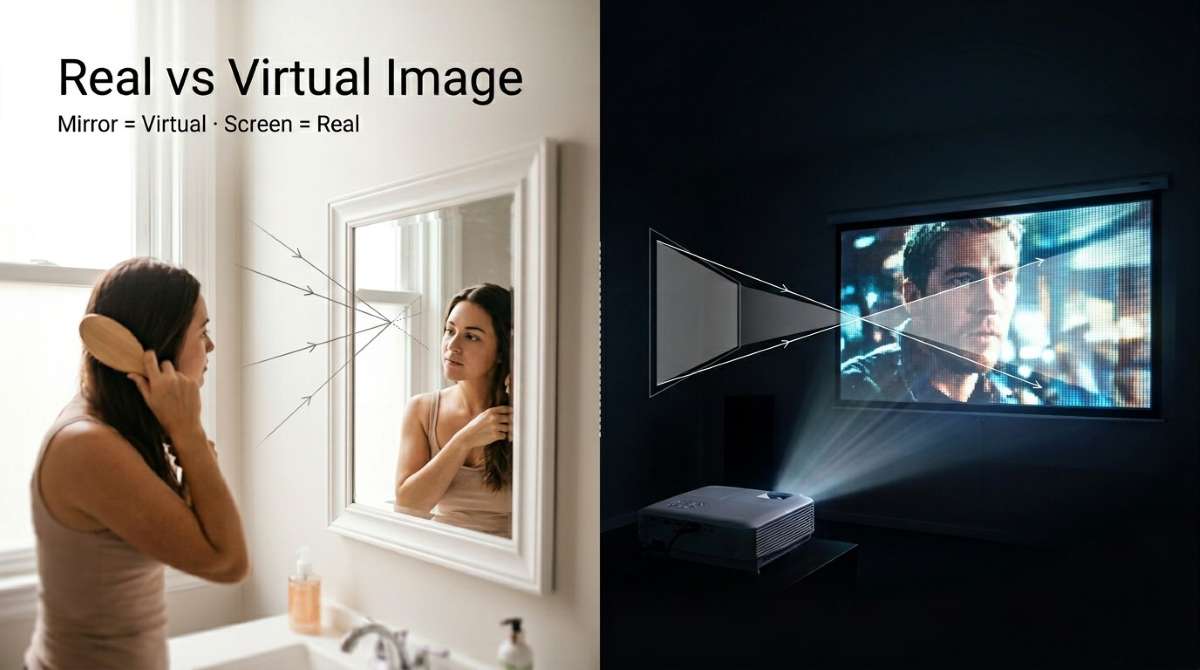
You brush your hair every morning by looking in a mirror. You can clearly see a perfect version of yourself looking back at you. But the person behind the glass is really a ghost. Right now, your eyes are seeing an optical illusion. Physics calls this a “virtual image” because the light rays never touch. A movie screen, on the other hand, shows a real picture. This shows that there are many different kinds of images in the world. To explain, let’s look at how light makes these beautiful things happen. You will be able to tell the difference right away and easily by the end.
Key Takeaways
- A white screen can catch real vs virtual image.
- Mirrors and lenses are the only places where virtual images can be seen.
- Light rays come together to make a real image.
- Rays only appear to meet for virtual images basically.
- Mirrors make fake images, while projectors make real ones.
Concept Brush-up Before We Dive Onto Difference
We need to be very clear about what these two ideas mean at first. When light hits reflective surfaces, it acts in very specific ways.
Real Image: a real image forms where light actually meets. Rays cross at a point. As a result, a screen can hold that image. By comparison, cameras and eyes capture it well. This is vital in photography. In short, real images are physically present in space.
Virtual Image: a virtual image forms where light seems to meet. To explain, rays do not truly cross there. You cannot catch it. At the same time, you can still see it. Mirrors often produce virtual images. In short, the image looks real but is not catchable.
Real vs Virtual Image — The Key Differences
Now that we know the basic concept of real and virtual image. We can look for real vs virtual image differences.
Table 1: Real vs Virtual Image
| Feature | Real Image | Virtual Image |
| Ray Meeting | Rays actually meet here to form image | Rays appear to meet but does not originally |
| Screen | Can be captured on screen | Virtual images cannot be captured |
| Orientation | Usually inverted for real image | For virtual image always upright |
| Position | Formed in front of mirror | Formed behind the mirror |
Real vs Virtual Image on Every Type of Mirror
Plane Mirror
Always Virtual. In fact, plane mirrors give only virtual images. To put it another way, no screen can catch them. At least, the images stay upright and same size. With this in mind, they are perfect for grooming.
Concave Mirror
When does it give real vs virtual image to explain, far objects give real inverted images. In contrast, very close objects give virtual magnified images. At the same time, dentists use the close case. With attention to distance, outcomes change very quickly.
Convex Mirror
Why it only gives Virtual Images. As has been noted, convex mirrors spread rays. With the result that, images stay smaller and virtual. In effect, drivers gain a wider field. At any rate, safety improves for everyone.
Real-Life Example:
Your reflection in a Spoon or Mirror to illustrate, a spoon’s back acts like a convex mirror. As a result, your face looks smaller and upright. By comparison, the spoon bowl acts concave. In detail, close up looks big and upright. At the same time, far away looks small and inverted. In sum, distance controls what you see.
Real vs Virtual Image on Every Type of Lens
Convex Lens
Real and Virtual Both Possible. In detail, far objects give real inverted images. With this purpose in mind, cameras use this setup. In contrast, very close objects give virtual images. To illustrate, magnifiers show bigger upright images. In short, object distance sets the image type.
Concave Lens
Always Virtual. In reality, concave lenses always give virtual images. To put it another way, they shrink and upright scenes. With attention to optics, myopia glasses use them. As a result, distant scenes appear smaller and clearer.
Real-Life Example:
How a Projector Creates a Real Image. At the present time, projectors use convex lenses. Bright light passes through a slide. With the result that, an image hits a wall. By comparison, that image is real and inverted. You can block it easily. In sum, projectors rely on real image formation.
Examples You See In Everyday Life
In short, you can find these pictures all over the place. Pay close attention to the shiny things in your house. Your eyes are always looking at things. Every second, you use reflection and refraction. With this in mind, physics is always interesting.
- Magnifying Glass: It makes a big virtual picture.
- Rearview Mirror: It gives you a wide virtual view.
- Cinema Screen: This is a huge real picture.
- Telescope Eyepiece: It makes a clear virtual picture.
Indeed, cameras employ sophisticated imaging devices. In this regard, such devices create true images. Such images falls on digital detectors in your phone. To clarify, lenses converge light rays to produce clear pictures.
Quick Tricks to Remember Real vs Virtual Image
“A real picture says “catch me if you can,” . You can on a screen! A virtual image just laughs and goes away.”
To repeat, a catchable image is real. In contrast, an uncatchable image is virtual. Real is often inverted in class. At the same time, virtual is usually upright. Predict the type correctly. Screen equals real, no screen equals virtual. This is how Real vs Virtual image gets classified.
Conclusion
In conclusion, there is an important contrast in real and virtual images because of their relation to light rays. As was mentioned above, real images occur whenever light rays intersect. They can be captured on a surface just like movies in the cinema. At the same time, virtual images seem to emerge from a point behind the mirror or lens. People can view them, but there is no way to project them on a surface.
Before moving to the conclusion, let us recall that plane and convex mirrors and concave lenses can only create virtual images. Concave mirrors and convex lenses, in turn, have the ability to generate both real and virtual images. It means that now it will be easier for you to find those optical phenomena in your surroundings!
Frequently Asked Questions
In reality, the light rays never go behind glass. They bounce off and enter eyes. Brain thinks they come from inside mirror. Since the rays do not meet, it’s virtual.
In general, they are inverted usually. This happens because light rays cross over. Second lens can flip them. This is how projectors show correct movies.
Real images are physically present in space. They are formed when light rays meet.
No, virtual images cannot the captured on screen This is the key difference in real image and virtual image.
Reference
Otero, M. R., & Arlego, M. F. (2023). Teaching and learning optics in high School: From Fermat to Feynman. Education Sciences, 13(5), 503. https://doi.org/10.3390/educsci13050503
- About the Author
- Latest Posts

As a digitally-adept technologist with a deep academic foundation in engineering, I have always been captivated by the fundamental laws that govern our physical universe. My journey into science began long before formal engineering studies, rooted in hands-on school laboratory experiments—from meticulously tracking projectile motion and verifying electromagnetic induction to analyzing circuit behaviors—where I learned firsthand that physical laws are not just formulas on a blackboard, but tangible, observable realities.
Today, my mission is to bridge the gap between complex engineering, advanced theoretical physics, and practical student understanding. Moving beyond abstract equations, I specialize in synthesizing intricate physical phenomena—ranging from the precise mechanics of classical systems and thermodynamics to the invisible forces of electromagnetism and modern technological integration—into precise, compelling educational narratives.
Driven by an insatiable curiosity for scientific discovery and systematic progress, I combine analytical rigor with a passion for science communication. Whether exploring how core physical principles drive disruptive innovations like autonomous systems, or breaking down textbook concepts and empirical insights for aspiring students and inquisitive enthusiasts, my goal is to make science accessible without sacrificing scientific integrity. By anchoring educational resources in disciplined inquiry, peer-reviewed insights, and practical experimentation, I aim to cultivate a pioneering spirit and inspire the next generation of thinkers to decode the mechanics of our collective future.