Light enters water and suddenly bounces back. It refuses to leave. This phenomenon powers your internet connection right now. Total internal reflection makes fiber optics work perfectly. Without it, modern communication would collapse instantly. Your smartphone for instance, depends on this physics principle every day. Doctors use it to see inside your body. Engineers use it to transmit data globally. As a matter of fact, this simple concept revolutionized technology. Let me show you how light performs this trick.
Estimated reading time: 7 minutes
Key Takeaways
- Total internal reflection occurs when light stays trapped inside
- Critical angle determines when this phenomenon happens exactly
- Optical fibers use this principle to carry internet data
- Snell’s Law helps us calculate all the angles precisely
- This technology powers endoscopy, binoculars, and global communications
What is Total Internal Reflection?
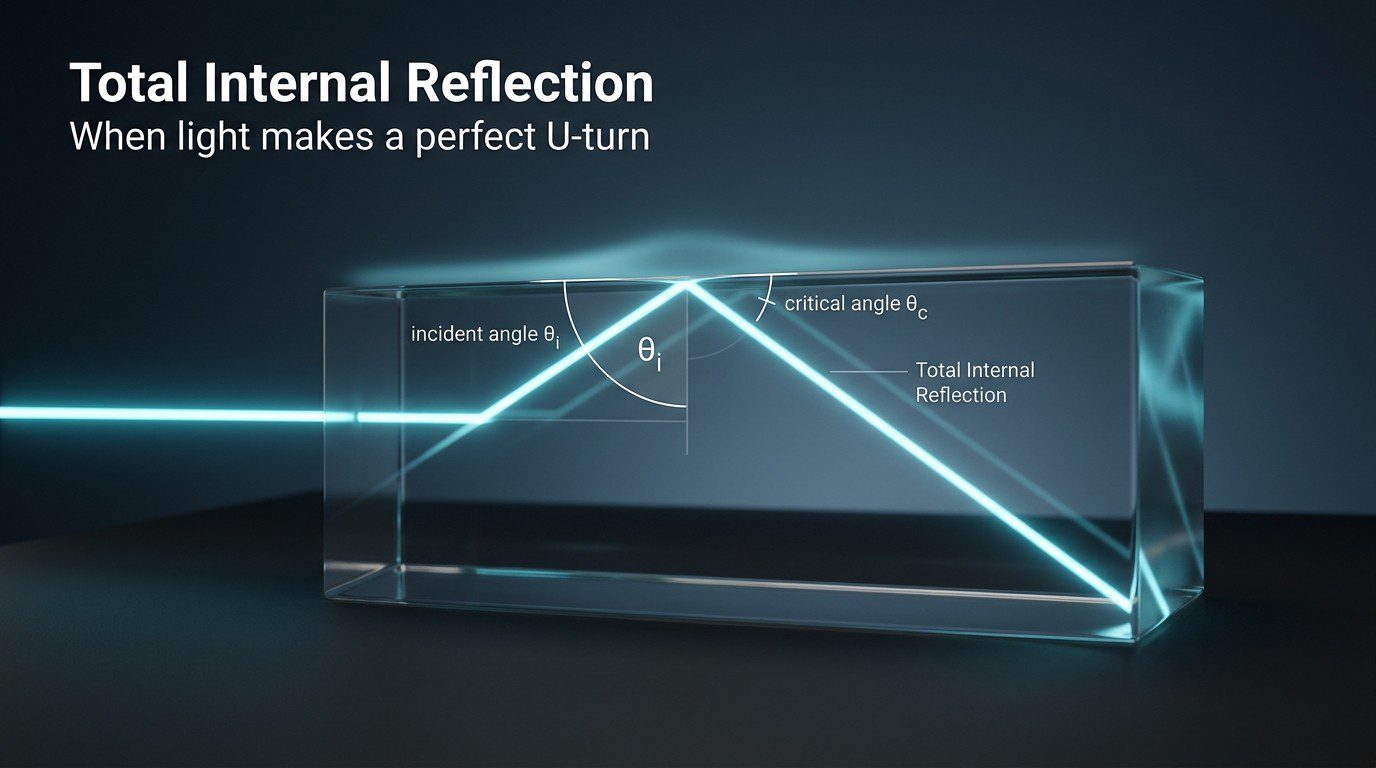
Total internal reflection (TIR) is light’s ultimate U-turn move. Light travels through a denser medium like glass. Then, it hits the boundary at a specific angle. Instead of escaping, it bounces back completely inside. As a result, zero light passes through to the other side.
At this point, the surface acts like a mirror. The reflection becomes 100% efficient and perfect. However, this happens only under two strict conditions.
A Simple Story to Understand
Imagine you’re swimming underwater in a pool. As you look up at the surface from below, something interesting happens. At certain angles, the water surface looks silvery. In fact, it acts like a perfect mirror above you. Indeed you can see your reflection instead of the sky. This happens because of total internal reflection. Light from below bounces back into the water. As a result, the surface becomes a natural mirror for you.
How is it Different ?
Mirrors reflect light whether you’re standing anywhere. Indeed total internal reflection needs special conditions to work. Above all, total internal reflection only happens at specific angles.
- Normal reflection: Happens at any angle on surfaces
- Partial reflection: Some light escapes, some reflects back
- Total internal reflection: All light stays trapped inside completely
- Efficiency: Total internal reflection wastes zero light energy
How Does This Phenomena Happen?
Refraction happens when light changes its traveling medium. In fact, understanding refraction helps explain total internal reflection better.
Two Necessary Conditions
Total internal reflection needs two conditions to occur. Most importantly, both conditions must be satisfied together. Missing one condition means it won’t happen. With that in mind, the conditions are:
Condition 1: Light must travel from denser to rarer medium. For example, glass to air or water to air.
Condition 2: The angle of incidence exceeds the critical angle. Also, light must hit the boundary at steep angles.
Step-by-Step Process
Let me break down the process for you:
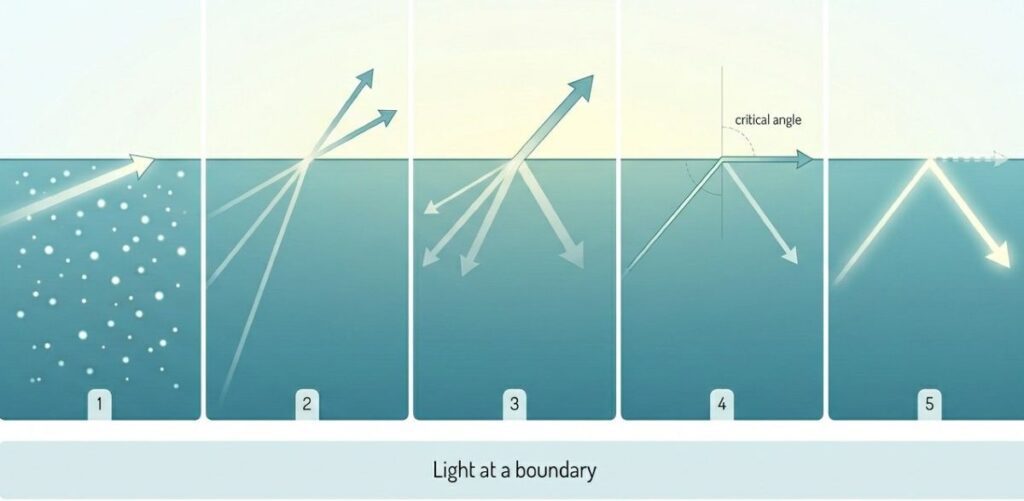
- Step 1:At first, light travels through the denser medium steadily. Everything still seems completely normal.
- Step 2: Next, light approaches the boundary at various angles. In fact, the angle determines exactly what happens next.
- Step 3: At small angles, most light passes through. At the same time, some light reflects back partially into the medium.
- Step 4: At the critical angle, light bends exactly 90 degrees. As a result it travels along the boundary surface precisely.
- Step 5: Beyond the critical angle, total internal reflection occurs. All light bounces back into the denser medium.
Mathematical angle
Snell’s Law is your best friend for calculations. Simply put, it connects angles and refractive indices mathematically perfectly.
To be specific, the formula is: n₁ sin θ₁ = n₂ sin θ₂
Where:
- n₁ = refractive index of first medium
- n₂ = refractive index of second medium
- θ₁ = angle of incidence
- θ₂ = angle of refraction
To illustrate, this formula predicts how light behaves.
How Snell’s Law Leads to total internal reflection
At the critical angle, the refracted angle equals 90°. Light bends parallel to the surface boundary exactly. To put it simply, Sin 90° equals 1 in mathematical terms precisely.
Because of this, the formula becomes: n₁ sin θc = n₂
where:
- θc = Critical Angle – θc
Rearranging gives us: sin θc = n₂/n₁
This equation calculates the critical angle for any medium. Of course, this only works provided that you know both refractive indices accurately.
Example For Formula
Problem: Find the critical angle for glass-air boundary. Glass has refractive index 1.5, air has 1.0.
Solution:
- sin θc = n₂/n₁ = 1.0/1.5 = 0.667
- θc = sin⁻¹(0.667) = 41.8°
In short, steeper angles always cause total internal reflection.
Difference Between three light phenomena
Total internal reflection combines aspects of both phenomena. To begin with light approaches a boundary like in refraction initially. However, it reflects back like in reflection completely. The key difference is efficiency and conditions required. For instance, normal reflection happens at any angle on surfaces. Thus it needs specific angles to occur.
Table 1: Reflection vs Refraction vs Total Internal Reflection
| Feature | Reflection | Refraction | Total Internal Reflection |
| Light behavior | Bounces back | Bends and passes | Bounces back completely |
| Medium change | No | Yes | No (stays in same medium) |
| Angle requirement | Any angle | Any angle | Above critical angle only |
| Efficiency | Varies | Some light lost | 100% efficient always |
| Common examples | Mirrors | Lenses | Optical fibers |
In summary, each phenomenon serves different technological purposes effectively.
Applications in Daily Life
Optical Fibers
Optical fibers are thin glass or plastic strands. Light enters one end and bounces along inside. Total internal reflection keeps light trapped inside perfectly. As a result, zero light escapes through the fiber’s curved walls. In similar fashion, data travels as light pulses. In fact, your internet connection uses millions of these fibers. They carry information across oceans and continents daily.
How Doctors Use it
Endoscopes are medical devices with optical fiber bundles. Doctors insert them into your body safely. First, light travels down through one fiber bundle. The light illuminates internal organs and tissues clearly. Meanwhile, another bundle carries the reflected image back. Doctors can see inside without major surgery required. In short, this saves lives every single day.
Periscopes and Binoculars
Periscopes use prisms instead of mirrors traditionally. Total internal reflection works better than silvered surfaces. As a result it gives clearer images without light loss. Binoculars also use prisms for the same reason. Inside, the prisms fold the light path efficiently inside. This makes binoculars compact and portable for users.
Closing remarks
To conclude, there is a lot more to total internal reflection than meets the eye; this phenomenon is actually behind much of the modern technologies in our lives. In fact, through the process of knowing how light is kept from escaping into a less dense medium by turning back upon itself when striking its boundary at a certain critical angle, one can understand how efficiently data is transferred through fiber optic cables all across the globe. For instance, from “natural mirrors” one encounters while swimming to the invaluable precision of endoscopes. Moreover, the super-fast internet connection we enjoy at home, it is clear that a little “light U-turn” is capable of changing the way we communicate for the better.
Frequently Asked Questions (FAQs)
At the critical angle, light bends exactly 90 degrees. It travels along the surface boundary precisely. Essentially, this is the turning point between two behaviors. Thus, light escapes into the rarer medium. Above it, total internal reflection occurs every time.
Yes, total internal reflection is completely efficient. In fact, unlike mirrors that lose some light, this wastes nothing at all. As a result, all light energy stays inside the medium. That is exactly why fiber optics use this principle. Simply put, it ensures maximum data transmission without any signal loss.
For TIR to happen, light must be able to speed up as it hits the boundary. In other words, when light moves from a denser medium to a rarer one, it bends away from the normal. Only then can it eventually reach the 90° mark and bounce back inside.
Regular reflection and total internal reflection are similar, yet different. In regular reflection, light simply bounces back partially. In total internal reflection, however, the light ray bounces back completely.
Reference
Fish, K. N. (2022c). Total Internal Reflection Fluorescence (TIRF) Microscopy. Current Protocols, 2(8), e517. https://doi.org/10.1002/cpz1.517
- About the Author
- Latest Posts

As a digitally-adept technologist with a deep academic foundation in engineering, I have always been captivated by the fundamental laws that govern our physical universe. My journey into science began long before formal engineering studies, rooted in hands-on school laboratory experiments—from meticulously tracking projectile motion and verifying electromagnetic induction to analyzing circuit behaviors—where I learned firsthand that physical laws are not just formulas on a blackboard, but tangible, observable realities.
Today, my mission is to bridge the gap between complex engineering, advanced theoretical physics, and practical student understanding. Moving beyond abstract equations, I specialize in synthesizing intricate physical phenomena—ranging from the precise mechanics of classical systems and thermodynamics to the invisible forces of electromagnetism and modern technological integration—into precise, compelling educational narratives.
Driven by an insatiable curiosity for scientific discovery and systematic progress, I combine analytical rigor with a passion for science communication. Whether exploring how core physical principles drive disruptive innovations like autonomous systems, or breaking down textbook concepts and empirical insights for aspiring students and inquisitive enthusiasts, my goal is to make science accessible without sacrificing scientific integrity. By anchoring educational resources in disciplined inquiry, peer-reviewed insights, and practical experimentation, I aim to cultivate a pioneering spirit and inspire the next generation of thinkers to decode the mechanics of our collective future.