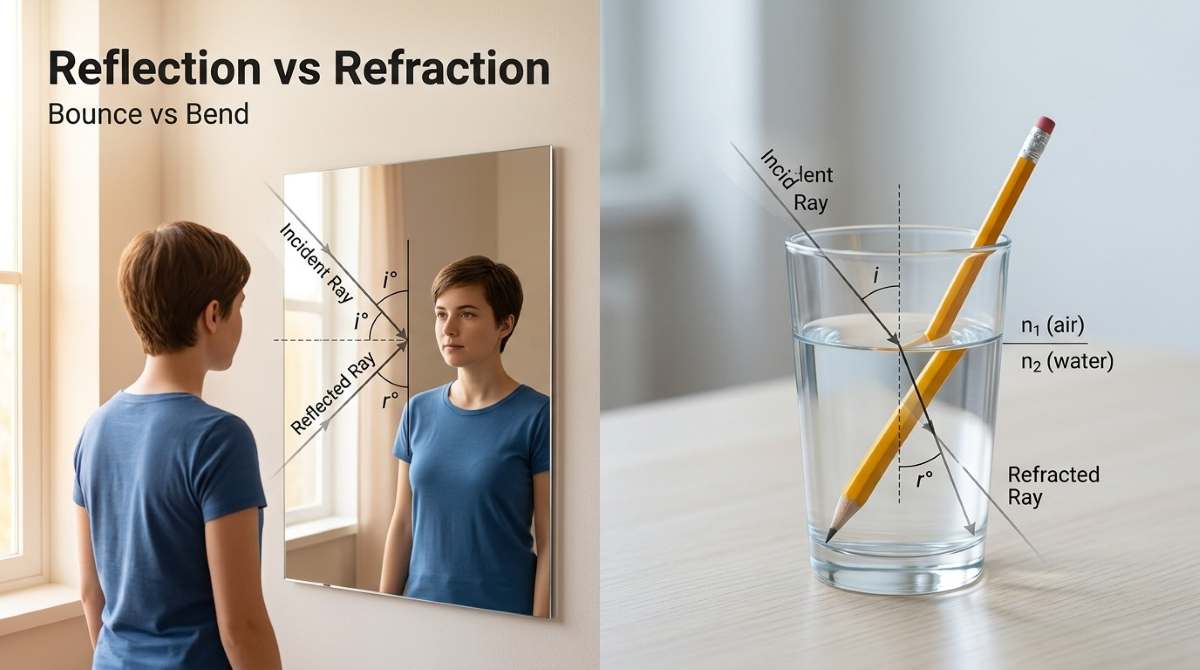
Have you noticed something strange about mirrors and water? They both play tricks with light. But the tricks are completely different. The difference between reflection and refraction of light with examples is simpler than you think. One bounces light back at you. The other bends light as it passes through. Science talks about both. But which is which? As a result, students often mix them up. After reading this, you’ll never confuse them again. All things considered, understanding these concepts unlocks advanced knowledge. So let’s get started.
Estimated reading time: 7 minutes
Key Takeaways
- Light reflection happens when light bounces off surfaces
- Both involve light changing direction in different ways
- Refraction occurs when light bends through different materials
- Real-world applications include mirrors, lenses, and fiber optics
- Snell’s law predicts exactly how much light will bend.
Understanding Basics Before Reflection vs Refraction
Before understanding the difference between reflection and refraction. Understanding the basics is essential.
Definition of Reflection: When Light Bounces Back
Light hits a surface. As a result, it bounces straight back. This is reflection. The light never enters the material. It stays in the same medium (like air). For instance think of a basketball hitting a wall. It comes back to you.
Definition of Refraction: When Light Bends Through Mediums
Refraction is different. Light actually enters a new material. To illustrate, it passes from air into water. The light bends as it enters. Thus this bending happens because light slows down.
Reflection vs Refraction: Key Differences at a Glance
This table shows the core differences clearly. At the same time, both involve light changing direction. However, the mechanisms are completely different.
Table 1: Reflection vs Refraction
| Feature | Reflection | Refraction |
|---|---|---|
| What happens | Light bounces back | Light bends and passes through |
| Medium change | No (stays in same medium) | Yes (enters new medium) |
| Speed of light | Stays the same | Changes (slows or speeds up) |
| Key law | Angle in = Angle out | Snell’s Law |
| Example | Mirror, shiny metal | Glass, water, lenses |
| Direction of light | Reversed (goes back) | Continues forward (but bent) |
| Energy loss | Minimal (almost no loss) | Some absorption can occur |
| Image formation | Always forms images | Can distort or displace images |
| Depends on surface | Yes (smooth vs rough) | No (depends on materials) |
| Wavelength change | No change in wavelength | Wavelength changes in new medium |
| Critical angle | Not applicable | Exists (for total internal reflection) |
| Color separation | No color separation | Can split white light (prism effect) |
How Reflection Works: Laws and Types
The Law of Reflection: Angle of Incidence vs. Angle of Reflection
Imagine throwing a ball at a wall. And it comes back at the same angle. Light does exactly the same thing. thus the incoming angle equals the outgoing angle. Generally scientists measure both angles from an imaginary perpendicular line.
This perpendicular line is called the “normal.” The angle of incidence is measured from the normal. Similarly for angle of reflection. This law may not work for both refraction and reflection.
Specular vs. Diffuse Reflection: Why Some Surfaces Shine
Not all reflections look the same. Significantly two main types exist:
- Specular reflection: Occurs on smooth, polished surfaces and all light rays bounce in the same direction
- Diffuse reflection: Happens on rough, uneven surfaces and light rays scatter in many different directions
How Refraction Works: Why Light Changes Speed
Refractive Index: The Role of Optical Density
Light travels at different speeds in different materials. This speed difference causes refraction. Generally scientists use a number called the refractive index. It measures how much a material slows light down. So a higher number means light slows down more. As a result, the bending becomes more dramatic.
Snell’s Law
Snell’s Law is a mathematical formula. Especially it predicts exactly how much light will bend. Snell’s Law gives the mathematical proof for the reflection vs refraction debate by calculating exactly how much light will bend The formula is: n₁ sin θ₁ = n₂ sin θ₂.
Let me break this down:
- n₁ = refractive index of first material
- θ₁ = angle of light in first material
- n₂ = refractive index of second material
- θ₂ = angle of light in second material
Real-Life Applications in Science and Tech
The phenomena of reflection and refraction have diverse applications. All in all they are the reason of visibility.
Reflection in Action: Mirrors, Periscopes, and Solar Cookers
Mirrors are the most obvious reflection application. But reflection does so much more.
Practical uses of reflection:
- Plane mirrors: Show your image in bathrooms and stores
- Curved mirrors: Used in telescopes to gather starlight
- Periscopes: Help submarines see above water using angled mirrors
- Solar cookers: Concentrate sunlight to cook food without electricity
- Car side mirrors: Keep you safe by showing traffic
Refraction in Action: Lenses, Rainbows, and Fiber Optics
Refraction powers many technologies you use every day. Eventually lenses are the most important refraction tool.
Where you find refraction:
- Eyeglasses: Bend light to correct your vision problems
- Cameras: Focus light onto sensors to capture photos
- Microscopes: Magnify tiny objects using multiple lenses together
- Rainbows: Form when sunlight refracts through water droplets
- Prisms: Split white light into beautiful color spectrums
These real life applications gives a clear understanding of the difference between reflection and refraction.
Closing Remarks
So let’s sum up what we’ve learned today. Reflection is light bouncing back from a surface. Refraction is light bending as it passes through materials. Above all, remember this trick: first stays in the same medium while later crosses boundaries. Think of reflection as a basketball bouncing off a wall. Think of refraction as a car driving from pavement onto sand and changing direction.
At length, these concepts aren’t just theory. They power mirrors in your bathroom. Similarly make your glasses work. Also enable high-speed internet through fiber optics. For the most part, modern technology depends on controlling light precisely. Understanding difference is your foundation for advanced physics. It unlocks topics like telescopes, microscopes, and laser technology.
With this in mind, test your knowledge right now. See how well you truly understand these concepts. With this purpose in mind, challenge yourself to explain these concepts to a friend. If you can teach it, you truly know it. So that you can master, keep practicing with everyday examples. Look for such phenomena all around you every single day.
Frequently Asked Questions
The main difference is simple. Reflection happens when light bounces off a surface. The light stays in the same material (like air). Refraction occurs when light passes through a boundary between materials. The light bends because it changes speed. Think of one as bouncing and another as bending. So next time you see a mirror, that’s reflection. When you see a bent pencil in water, that’s refraction.
Total internal reflection is a special case of reflection. It happens when light tries to leave a dense material. If the angle is too steep, the light reflects back completely. Nothing refracts out. This is super important for fiber optic cables. They carry internet signals using light. The light bounces inside the cable without escaping. That’s how data travels so fast over long distances.
The refractive index tells you how much light slows down. Air has a refractive index near 1. It bends light dramatically. Understanding refractive index helps predict how light will behave.
Absolutely! This happens all the time. When light hits a glass window, some reflects back. At the same time, some refracts through the glass. That’s why you can see your reflection in a window. But you can also see through it. The amount of each depends on the angle. It also depends on the materials involved. Both processes can happen together at the same boundary.
References
Schur, Y., Guberman, A., & Ovsyannikov, S. (2025b). Promoting understanding of the concept of the refraction of light through the use of attentive teaching. Education Sciences, 15(2), 118. https://doi.org/10.3390/educsci15020118
- About the Author
- Latest Posts

As a digitally-adept technologist with a deep academic foundation in engineering, I have always been captivated by the fundamental laws that govern our physical universe. My journey into science began long before formal engineering studies, rooted in hands-on school laboratory experiments—from meticulously tracking projectile motion and verifying electromagnetic induction to analyzing circuit behaviors—where I learned firsthand that physical laws are not just formulas on a blackboard, but tangible, observable realities.
Today, my mission is to bridge the gap between complex engineering, advanced theoretical physics, and practical student understanding. Moving beyond abstract equations, I specialize in synthesizing intricate physical phenomena—ranging from the precise mechanics of classical systems and thermodynamics to the invisible forces of electromagnetism and modern technological integration—into precise, compelling educational narratives.
Driven by an insatiable curiosity for scientific discovery and systematic progress, I combine analytical rigor with a passion for science communication. Whether exploring how core physical principles drive disruptive innovations like autonomous systems, or breaking down textbook concepts and empirical insights for aspiring students and inquisitive enthusiasts, my goal is to make science accessible without sacrificing scientific integrity. By anchoring educational resources in disciplined inquiry, peer-reviewed insights, and practical experimentation, I aim to cultivate a pioneering spirit and inspire the next generation of thinkers to decode the mechanics of our collective future.