
Estimated reading time: 13 minutes
Why planets move around the Sun and why objects fall to the Earth? All of this happens because of gravity. Essentially, gravity is a force that pulls objects toward each other and keeps everything in place. Without gravity, people and objects would simply float away into endless space. Here, gravity affects everything around us constantly. For instance, it holds our atmosphere close to earth, allowing us to breathe. Additionally, gravity keeps oceans in their basins and prevents water from drifting into space. Moreover, the Sun’s gravity holds all eight planets in their orbits, maintaining the structure of our solar system.
In the 17th century, Isaac Newton explained gravity through his Law of Universal Gravitation after observing an apple fall from a tree. Consequently, this simple observation led to one of history’s most important scientific discoveries. Specifically, this law states that every object in the universe pulls every other object toward itself. The, two factors determine gravitational strength. First, bigger objects have stronger gravity, so this explains why earth pulls us down , while we barely notice a book’s gravitational pull. Second, objects farther apart have weaker gravity between them.
Newton’s Law of Gravitation remains extremely important because it explains how planets, moons, and other celestial objects move in space. Subsequently, scientists have used this law to launch satellites, sending astronauts to the Moon, and to explore distant planets. Therefore, understanding gravity will helps us comprehend both everyday experiences and the vast movements of the cosmos.In this blog, You will learn how gravity works in our everyday lives and discover why this invisible force shapes everything around us.
What is Newton’s Law of Gravitation: Key Takeaways
- Newton’s law of Gravitation states that every object attracts every other object with a force called gravity.
- The strength of gravity depends on the mass of the objects and the distance between them: larger mass means stronger gravitational pull, while greater distance weakens it.
- This law explains the motion of planets, moons, and satellites in space, and it also accounts for phenomena like ocean tides.
- Additionally, gravity always pulls objects together and never pushes them apart, and it acts over distances without requiring contact.
- Although Newton’s law is fundamental, it has limitations and does not accurately describe gravity in extreme conditions, like near black holes or at light speed.
- The formulae for Newton’s Law of Gravitation is:
What is Newton’s Law of Gravitation?
Newton’s Law of Gravitation states that every object in the universe will attract every other object through gravity. This fundamental principle governs everything, from falling raindrops to orbiting planets. Objects with greater mass exert stronger gravitational force. For instance, the Sun dominates our solar system because it contains 99.8% of its total mass. Similarly, the earth’s massive size allows it to hold our atmosphere and oceans firmly in place. In contrast, smaller objects like basketballs exert gravitational pull too weak to detect.
Gravitational force weakens as distance increases. Specifically, when you double the distance between two objects, gravity becomes four times weaker. This principle explains why astronauts experience weightlessness while orbiting earth. However, gravity never disappears completely. So it extends infinitely across the vastness of space. Earth’s gravity constantly pulls objects toward the ground.
When you jump, gravity immediately brings you back down. Here, gravity keeps the moon orbiting earth and all planets orbiting the Sun. Without this gravitational bond, celestial bodies would drift aimlessly through space. Even small objects attract each other through gravity. Two books sitting on a table pull toward each other. However, only massive objects like planets and stars produce gravitational effects strong enough for humans to notice and measure.
Also Read: Reflection vs Refraction.
Mathematical formula of Newton’s Law of Gravitation
The mathematical formula for Newton’s Law of Gravitation is:
F = G × (m₁ × m₂) / r²
Understanding Each Variable:
- F represents the gravitational force between two objects, measured in Newtons (N).
- G stands for the gravitational constant, which equals 6.674 × 10⁻¹¹ N⋅m²/kg². This value remains the same throughout the universe.
- m₁ represents the mass of the first object, measured in kilograms (kg).
- m₂ represents the mass of the second object, measured in kilograms (kg).
- r represents the distance between the centers of both objects, measured in meters (m).
How the Formula Works:
This equation shows that gravitational force increases when objects have greater mass. Consequently, multiplying m₁ and m₂ produces a larger force. However, the formula also demonstrates that gravity weakens with distance. Specifically, the r² term means that doubling the distance reduces gravitational force by four times.
Practical Application:
Scientists use this formula to calculate gravitational attraction between any two objects. For instance, astronomers apply it to predict planetary orbits, while engineers use it when launching satellites into space. Therefore, this simple equation enables humanity to explore the cosmos.
This formula demonstrates that gravity depends on both mass and distance. Consequently, scientists use it to calculate gravitational interactions between any objects in the universe.
Also Read: Laws of Reflection.
Properties of Gravitational Force
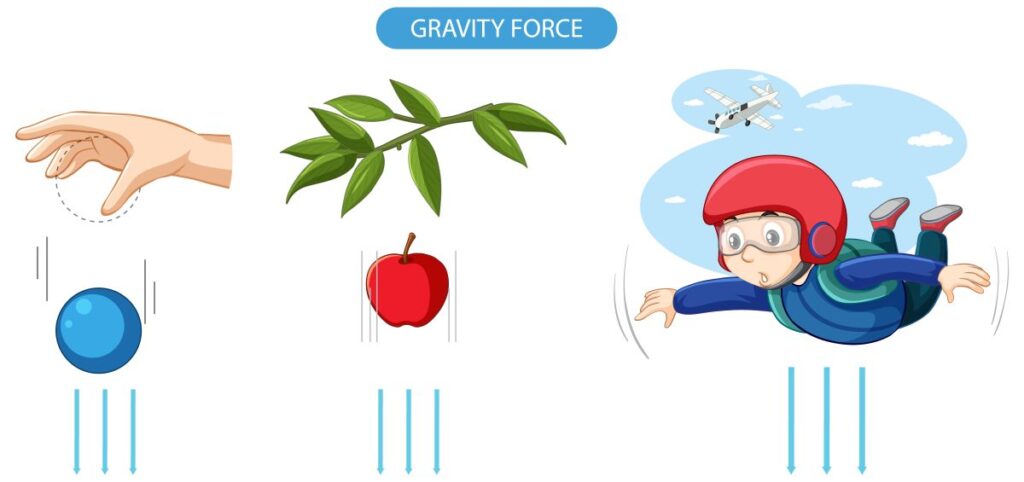
Here are the properties of gravitational force:
- The gravitational force is often known as a long-range force, which will exist between two particles, regardless of the medium that separates them.
- The gravitational force is directly proportional to the product of the mass of the two bodies. Hence, it means a larger mass will yield a larger force.
- The force obeys the inverse square law. Subsequently, the force is inversely proportional to the square of the distance between them.
- On the surface of the earth, the gravitational force produces a constant acceleration, g = 9.8 m/s2.
- Gravitational force always acts as a force of attraction. Subsequently, It tries to pull masses together, it never pushes them apart.
- It is independent of the intervening medium.
- Gravitational force is the one of the weakest of the four fundamental forces.
- It acts along the line joining the centre of the two objects. Therefore, it is called the central force.
- Gravitational force is directly proportional to the weight.
- Gravitational force acts even when the objects are not in touch.
Real-life examples of Newton’s Law of Gravitation
1. Why we stay on the ground?
The massive earth exerts a strong gravitational pull that keeps us firmly on the ground. Without this force, we would float away into space. Additionally, earth’s gravity holds our atmosphere, oceans, and everything on its surface securely in place. Hence, this gravitational force allows us to walk, run, and perform daily activities. Every time you jump, earth’s gravity pulls you back down. Consequently, gravity makes life on our planet possible and stable.
2. Motion of planets
The Sun’s gravitational force pulls planets toward it, keeping them moving in their orbits. Consequently, all eight planets travel around the Sun in predictable paths rather than drifting into space. For instance, earth completes one orbit around the Sun every 365 days, creating our year. Similarly, other planets follow their own orbital periods. Without the Sun’s gravitational pull, planets would scatter randomly throughout the universe, and our solar system would cease to exist.
3. Ocean tides
The gravitational pull of the Moon and Sun causes ocean tides. When the Moon passes overhead, it pulls ocean water toward itself, creating high tides. As the Moon moves away, water recedes, causing low tides. Interestingly, most coastlines experience two high tides and two low tides daily. Hence, when the Sun and Moon align during full or new moons, they create stronger “spring tides.” Conversely, when they pull at right angles, weaker “neap tides” occur.
Story Behind the Discovery of Newton’s Law of Gravitation: From Apples to Planets

In 1666, a young Sir Isaac Newton was sitting under an apple tree at his family’s farm in Woolsthorpe, England, when he watched an apple fall to the ground. This ordinary moment triggered an extraordinary question:
Why do objects always fall straight toward the earth?
Newton’s curiosity didn’t stop at the orchard. He wondered if the same invisible force pulling the apple downward was also responsible for keeping the moon in its orbit around Earth. At the time, no scientist had ever connected Earth’s gravity to the mechanics of outer space.
As a result, Newton dedicated years to studying gravity and its effects. Through careful observation and mathematical analysis, he explained that every object in the universe pulls every other object toward itself with a force called gravity. Hence, he discovered that objects with greater mass exert stronger gravitational pull. Additionally, he also proved that gravity keeps the moon moving around earth and all planets moving around the Sun in their orbital paths.
Newton also developed precise mathematical formulas to calculate gravitational force between any two objects. These equations enabled scientists to predict planetary movements accurately for the first time.
In 1687, Newton published his revolutionary discoveries in a famous book called “Principia Mathematica” (Mathematical Principles of Natural Philosophy). This masterpiece became one of the most important science books in history. Subsequently, it transformed our understanding of the universe and laid the foundation for modern physics. Today, we still rely on these exact principles. When NASA engineers launch rockets, position satellites, or plot paths for deep-space missions, they are using the mathematical foundations Newton figured out nearly 350 years ago.
Also Read: What Are Irrational Numbers and their examples.
Statements of Newton’s Law of Gravitation
Newton’s Law of Gravitation states that every particle in the universe attracts every other particle with a force called gravity. This fundamental principle applies to everything, that is from tiny atoms to massive galaxies. Consequently, gravity connects all matter throughout the cosmos in an invisible web of attraction.
Mass and gravitational strength:
The gravitational force is directly proportional to the product of the masses of two objects. This means that objects with greater mass have a stronger gravitational pull. For instance, the Sun contains approximately 333,000 times more mass than earth. As a result, the Sun exerts an enormously powerful gravitational force that holds all eight planets in their orbits.
Similarly, earth’s mass allows it to generate enough gravity to hold our atmosphere, oceans, and everything on its surface. In contrast, the Moon has only 1/6th of earth’s mass. Consequently, astronauts who walked on the Moon experienced much weaker gravity and could jump six times higher than on earth.
Distance and gravitational force:
However, the force of gravity is inversely proportional to the square of the distance between the centers of two objects. In other words, when the distance between two objects increases, the gravitational force between them becomes significantly weaker. Specifically, if you double the distance, gravity becomes four times weaker. If you triple the distance, gravity becomes nine times weaker.
This principle explains why spacecraft can eventually escape earth’s gravitational pull. As rockets travel farther from earth, they experience progressively weaker gravity. Hence, this relationship helps scientists understand why distant planets like Neptune receive much less solar gravitational influence than Mercury, which orbits closest to the Sun.
Massive celestial objects:
Therefore, bigger objects like earth, the Sun, and the planets have very strong gravitational forces because they contain large amounts of mass. The Sun dominates our solar system gravitationally, containing 99.8% of the total mass. Jupiter, the largest planet, exerts gravity strong enough to influence asteroid paths and protect inner planets from cosmic collisions.
Moreover, gravity from massive objects can bend light and distort space itself. Scientists call this phenomenon gravitational lensing, which astronomers use to study distant galaxies.
Everyday applications:
Understanding Newton’s Law of Gravitation enables remarkable achievements. Engineers use these principles to calculate satellite orbits, plan interplanetary missions, and predict celestial events like eclipses. Additionally, GPS systems rely on gravitational calculations to provide accurate positioning data worldwide.
Also Read: Understanding Properties of States of Matter
Universal Gravitational Constant (G)
When Sir Isaac Newton first published his ideas in the famous book Principia Mathematica in 1687, he explained the law of gravitation but did not include the value of the gravitational constant (G). Although Newton understood that gravity existed, he lacked the tools to measure its exact strength. Consequently, scientists spent over a century searching for this crucial value. In 1798, British scientist Henry Cavendish conducted a brilliant experiment to measure G. He used a device called a torsion balance, which consisted of two small lead spheres attached to a rod suspended by a thin wire. When Cavendish placed larger lead spheres nearby, the smaller spheres moved slightly toward them due to gravitational attraction. By measuring this tiny movement, Cavendish calculated the gravitational constant with remarkable accuracy.
Subsequently, Cavendish’s experiment achieved something extraordinary, it allowed scientists to “weigh the earth” for the first time. Using his measured value of G, physicists could finally calculate earth’s total mass. After Cavendish’s pioneering work, many other physicists improved the measurements over time. Scientists developed more sensitive equipment and refined experimental techniques. However, measuring G remains challenging because gravitational force between small objects is extremely weak compared to other forces.
Today, the accepted CODATA value of the Universal Gravitational Constant (G) is approximately:
G = 6.674 × 10⁻¹¹ N⋅m²/kg²
This remarkably small number explains why we only notice gravity from massive objects like earth. This constant is essential because it helps scientists calculate the gravitational force between any objects in the universe. Astronomers use G to determine planetary masses, predict orbital paths, and plan space missions. Additionally, engineers rely on G when launching satellites and calculating spacecraft trajectories.
Also Read: Inside Your Kidneys: How Structure Meets Function
How Newton’s Law of Gravitation Works?
Newton’s Law of Gravitation explains that all objects in the universe pull each other with a force called gravity. This fundamental principle governs everything from falling raindrops to orbiting galaxies. The strength of gravity depends on two critical factors: the mass of the objects and the distance between them. Understanding these factors helps scientists predict how objects interact throughout the cosmos.
For example, earth’s strong gravity keeps us firmly planted on the ground, holds our atmosphere in place, and prevents oceans from floating into space. Without earth’s gravitational pull, life as we know it would be impossible. Similarly, the Sun’s enormous gravity keeps all eight planets moving in their orbits, maintaining the structure of our solar system for billions of years. However, gravity becomes weaker when objects move farther apart, which explains why distant planets like Neptune experience less solar gravitational influence than Mercury.
Conclusion: What is Newton’s Law of Gravitation
Newton’s Law of Gravitation explains how gravity works and why objects attract each other. This fundamental principle revolutionized our understanding of the universe and continues to shape modern science. It helps us understand why objects fall to the ground when dropped, how planets and moons move through space in predictable orbits, and why ocean tides rise and fall as the Moon passes overhead. Hence, this important law helped scientists make groundbreaking discoveries in physics, astronomy, and space science.
For instance, astronomers used Newton’s equations to discover Neptune before observing it directly. Similarly, engineers apply these principles when launching satellites and planning interplanetary missions. Although Einstein’s Theory of General Relativity later expanded our understanding of gravity, Newton’s law remains essential for everyday calculations. Scientists, engineers, and students worldwide continue using Newton’s simple yet powerful formula.
In conclusion, Newton’s Law of Gravitation stands as one of history’s most significant scientific achievements, connecting the falling apple in your backyard to the orbiting planets in our solar system and demonstrating that one universal force governs all matter throughout the cosmos.
Frequently asked questions (FAQs)
This law states that every object with mass attracts every other object with mass through gravitational force.
Mainly the Planetary motion, satellite orbits, and ocean tides on earth.
The gravitational force formula is F = G(m₁m₂)/r².
It did not explain formation of blackholes and the speed of light.
“Principia Mathematica” (Mathematical Principles of Natural Philosophy).
The two main factors affecting gravitational force are mass and distance between objects.
Gravitational force decreases with the square of the distance. Doubling the distance reduces the force to one-quarter.
References:
- Ferrè, E. R., Frett, T., Haggard, P., & Longo, M. R. (2019). A gravitational contribution to perceived body weight. Scientific Reports, 9(1). https://doi.org/10.1038/s41598-019-47663-x
- Holstein, B. R. (2006). Graviton physics. American Journal of Physics, 74(11), 1002–1011. https://doi.org/10.1119/1.2338547
- Rothleitner, C., & Schlamminger, S. (2017). Invited review article: Measurements of the Newtonian constant of gravitation, G. Review of Scientific Instruments, 88(11), 111101. https://doi.org/10.1063/1.4994619
- Verlinde, E. P. (2010). On the Origin of Gravity and the Laws of Newton. arXiv (Cornell University). https://doi.org/10.48550/arxiv.1001.0785
- Marchese, M. M., Plávala, M., Kleinmann, M., & Nimmrichter, S. (2025). Newton’s laws of motion generating gravity-mediated entanglement. Physical Review. A/Physical Review, A, 111(4). https://doi.org/10.1103/physreva.111.042202
- About the Author
- Latest Posts

Ms. Adrita Roy is a dual master’s holder specializing in Biological Sciences and Sustainable Development. She completed her Master’s in Biological Sciences from Bangalore University in 2025, followed by a Master’s in Sustainable Development from the University of Sussex in 2026.
With over three years of professional experience across biosciences, sustainability, education, ESG consulting, and science communication, Ms. Roy has developed a multidisciplinary profile focused on research, sustainability, and impactful communication.
Her subject expertise includes Biological Sciences, Sustainable Development, ESG consulting and sustainability frameworks, science communication, environmental awareness communication, and sustainability-focused content development. She also possesses expertise in Biology and Chemistry academic content development for Classes 11 and 12, including MCQs, assignments, case studies, and educational learning resources.
Ms. Roy is experienced in scientific writing, journal drafting, research communication, policy drafting, stakeholder engagement, sustainability reporting, web content creation, marketing communication, case study preparation, and master sheet preparation. Her multidisciplinary background enables her to combine research-oriented knowledge with effective communication strategies in the fields of science, sustainability, and education.